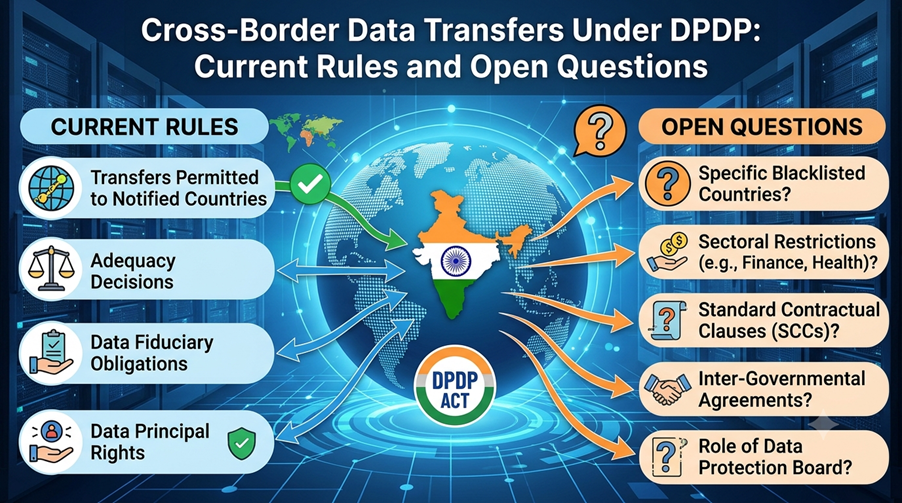
Cross-border data transfers under DPDP raise important questions for Indian businesses using overseas cloud services, international support teams and global technology providers.
Imagine a Noida start-up has a cloud service in Virginia storing customer data, and a support team in Manila who access it each day. Is it compliant with India’s new privacy law? The simple answer: “Mostly yes, but ask me again in a week.”
Cross-Border Data Transfers Under DPDP: What Businesses Need to Know
India opted for an easier path than the GDPR’s adequacy-and-clauses framework. According to Section 16 of the Digital Personal Data Protection Act, the Central Government can prohibit transfers to countries it has notified, but Rule 15 thereafter authorizes transfers outside India to the extent the Central Government lays down rules about making data available to a foreign State or those under its jurisdiction by general or special order. This can be seen as a relaxation, as the two conditions in the draft regulation are combined into a single rule; without any government order, data is free to leave India. Therefore, default open, but can be closed by notification at any time.
The calendar problem
A lot of it was really just about the timing. Rule 13 was notified on 13 November 2025, but that set into motion a phased clock rather than a single deadline. Rule 15 is in the final phase, with a proposed coming-into-force date of 13 May 2027. In September 2026, Section 16 and Rule 15 had not yet begun, according to one analysis. A Bar & Bench column asked why contracts are being rewritten as though transfer rules are already live.
In the meantime, existing laws stay in force. Section 16(2) saves laws granting greater protection or imposing more restrictions on transfers, which is particularly relevant in a heavily regulated space. The RBI’s payment-data localisation order is the most well-known.
Where the real questions lie
Is the clock ticking? In January 2026, MeitY proposed to cut timelines. The move would make Rule 15 and Rule 13(5) (transfer rules by Significant Data Fiduciaries) go live immediately, subject to implementation. Industry opposed on legacy systems and localisation levels, and I haven’t been able to confirm whether that has been settled, so for now, check the Gazette.
And the stricter guidelines, for whom? Among Significant Data Fiduciaries: The Rules mandate that any personal data and contents – including monitoring logs, accessed or processing details, and so on – should not be offshore without approval (Rule 13). The Rules consider localisation, for those types, according to committee suggestions. Which types, and who’s on that committee, are right now a secret.
What will the government’s directions state? The scope of access to ‘foreign State’ in Rule 15 will be intentionally unspecified. Will directions specify countries, parts of the economy, data types? Until this starts to emerge, lawyers are discussing a blank page.
What to do now
The map of where your data really goes (including sub-processors and external tools). Make your contracts nimble enough for you to tag a notification on later, rather than hard-coding assumptions. Watch the Gazette, not the feeding frenzy. And if you’re a bank, insurer or payments firm, your sector regulation already obliges you to!
Trust-first for the moment, but a single notification could change that.
This is common information and not legal advice. You should seek legal advice from a lawyer in your practice area and practice area.
To understand when these provisions become applicable, read our guide to the DPDP Rules timeline 2026–27 and the phased implementation of India’s data protection framework.
References
- 1. DPDP Act, 2023 – Section 16: Official DPDP Act PDF
- Place in “A permissive start”.
- 2. DPDP Rules, 2025 – Rule 15: Official MeitY Gazette notification
- Place beside your explanation of overseas transfers and government orders. The notification is G.S.R. 846(E). MeitY+1
- 3. RBI – Storage of Payment System Data: RBI payment data storage circular
- Place in “The calendar problem” when discussing sector-specific localisation requirements.
- 4. January 2026 timeline proposal: Business Standard report on proposed DPDP timeline changes
- Use this to support the discussion of the proposed acceleration, while making clear it was a proposal, not an enacted change. Tech News – Business Standard+1
Plagiarized
AI Detection
Proof reading