A decarbonisation roadmap helps hard-to-abate sectors such as steel, cement and chemicals reduce industrial emissions through energy efficiency, fuel switching and carbon capture.
We all know how to cut pollution from cars and power plants now. Put solar, buy EV, done. But what about cement, steel, chemicals, fertilizers? How do you make them clean?That’s the real headache. These industries are called hard-to-abate for a reason. Not because people are lazy, but because you can’t just replace coal with a solar panel and fix it.
Their pollution comes from the process itself. And they make almost 30% of world’s total emissions. So if we don’t fix them, net-zero is impossible.I understood this properly when I visited a cement plant near Raipur last year. The engineer told me – our kiln runs at 1400 degrees. You can’t get that heat from electricity easily. Plus, when we make cement, CO2 comes out from limestone itself. Even if you run the whole plant on green power, that chemical CO2 will still come. That’s why Heavy industry faces a major transition, not just a fuel change.
What Does a Practical Decarbonisation Roadmap Look Like?
There are three big reasons why hard-to-abate is actually hard.First is heat. Steel needs 1500 degrees, cement needs 1400. Normal electric heaters can’t give that much stable heat for 24 hours. So companies still burn coal.Second is chemistry. In cement, you heat limestone and it breaks and releases CO2. That’s not from fuel, that’s from the rock itself.
Same with chemicals. So even if you change fuel, 60% emission remainsThird is money and life. A steel plant costs thousands of crores and runs for 40 years. You can’t just shut it and build a new green one tomorrow. If you build a dirty plant today, it will pollute till 2065. That’s called lock-in.That’s why without a proper decarbonisation roadmap, companies will get stuck. And with Europe’s new CBAM carbon tax, they will have to pay heavy penalty to export.
So what does a practical roadmap actually look like?
No company can become green overnight. Good roadmaps are in three phases. This is what Tata Steel and Ambuja are also trying.
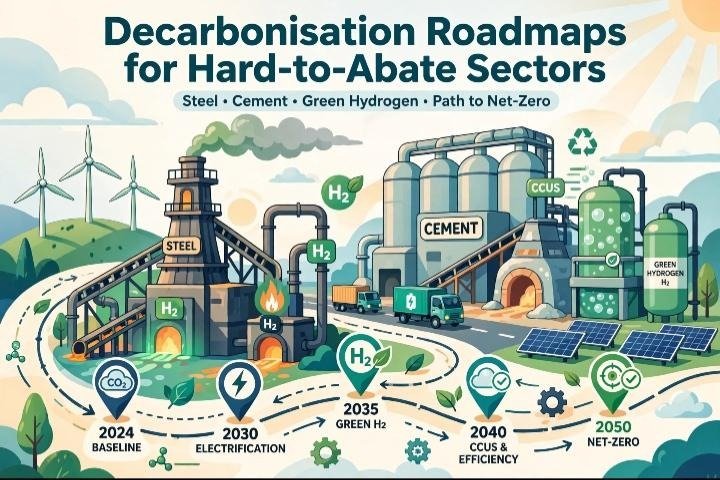
*Phase 1 – Do what you can today (till 2030)*
This is low hanging fruit. Increase energy efficiency, use more scrap steel instead of fresh iron, mix fly ash and slag in cement to reduce clinker, replace some coal with biomass and waste plastic. It doesn’t need huge money and can cut 10-15% emissions quickly. Most Indian plants are in this phase right now.
*Phase 2 – Change the fuel (2030-2040)*
This is the big shift. For steel, use green hydrogen instead of coal to make iron. This is called H2-DRI. For cement, use electric kilns powered by green power, and develop new cements that need less limestone. But this needs green hydrogen at cheap rate, like 1-2 dollars per kg. Right now it’s 4-5 dollars. So it needs government support. India’s National Green Hydrogen Mission is pushing for this.
*Phase 3 – Catch the remaining CO2 (2040-2050)*
Even after all this, some CO2 will still come. For that you need Carbon Capture. You catch CO2 from chimney and either store it underground or use it to make fuels. And you recycle everything. Steel can be recycled infinitely, cement can be reused. That makes you truly net-zero.
This three step decarbonisation roadmap is the only way forward for heavy industry.
Why India should actually lead this?
People think this transition is burden for India. I think its opportunity.India is going to build 70% of its buildings, bridges, roads that we need by 2047. We haven’t built them yet. So we can choose to build them green from start, unlike Europe which has to replace old plants.Plus, world is ready to pay extra for green steel and green cement.
If an Indian company makes green steel today, it can charge premium from European car companies who need it for their own ESG targets. So early movers will earn more.Companies who start planning their roadmap now will not only avoid carbon taxes but will get cheaper green finance from banks too.
Conclusion
Cleaning up power and cars was the easy part. The tough part starts now. Decarbonising hard-to-abate sectors will decide if we actually stop climate change or not.It won’t happen with one technology or one law. It needs a proper step-by-step roadmap – efficiency first, then fuel switch, then carbon capture.
For Indian steel and cement companies, the question is no longer if they should change, but how fast they will change. Those who start now will lead the next industrial era. Those who wait will be left with old plants that no one wants to buy from.
Companies can also support their decarbonisation roadmap through circular economy in manufacturing practices, including material reuse, recycling and resource efficiency.
References
1. “Climate change mitigation,” _Wikipedia, The Free Encyclopedia._, Climate_change_mitigation
2. “Hard-to-abate sectors,” _Wikipedia, The Free Encyclopedia._, Hard-to-abate_sectors
3. “Carbon capture and storage,” _Wikipedia, The Free Encyclopedia._, Carbon_capture_and_storage