Research and Promotion Intern | Eve Paper
Keywords: lean six sigma, service operations
Lean Six Sigma in service businesses helps teams reduce operational waste, improve process consistency and deliver better customer experiences without relying on staff cuts.
When I first heard “Lean Six Sigma,” I pictured a car plant: hard hats, assembly lines, defect counts on a big screen. So I was surprised, while researching this post, by how much of the writing is about banks, hospitals and help desks. Efficiency programs are moving out of manufacturing, and in 2026 that’s getting hard to ignore.
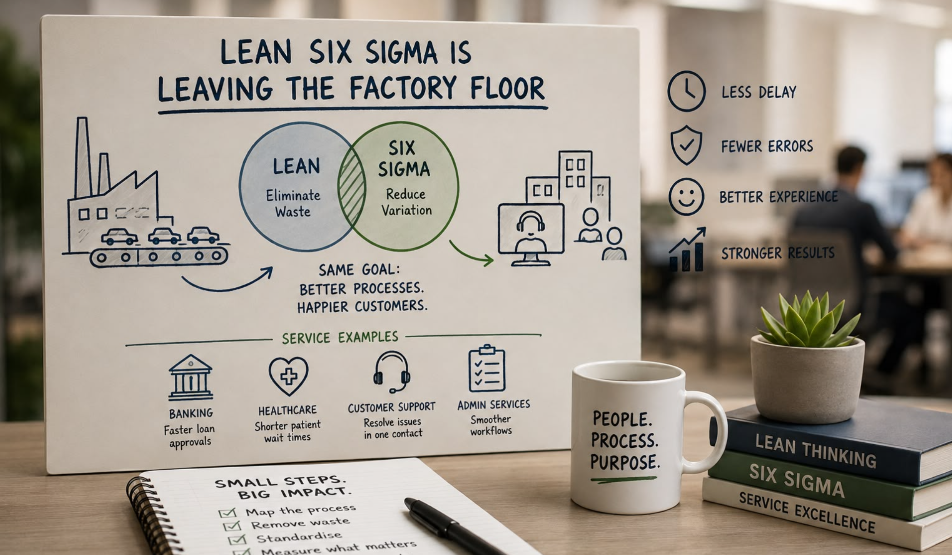
The above given image is generated by chatgpt
5 Practical Lean Six Sigma Wins for Service Businesses in 2026
The short version is that Lean cuts waste and Six Sigma cuts variation [1]. Ask where time disappears and why one customer gets a different experience from the next, and you’ve got most of the idea. Services have plenty of both. A loan file sits untouched for three days. A support ticket bounces between teams. George describes this kind of delay as the service version of factory scrap [2], which I found a useful comparison, because nobody can see a pile of waiting emails the way they can see a pile of scrap metal.
Service firms were slow to adopt these methods. An early UK survey found that many saw the tools as better suited to manufacturing [3]. Pressure is changing that: labour costs are up, margins are thin, and customers expect answers today. Managers need savings that don’t just mean fewer people.
Small wins that seem realistic
A few ideas kept turning up in what I read:
1. Map the journey. A simple process map often shows that most elapsed time is waiting, not work. A whiteboard is enough.
2. Cut a handoff. Each one is a chance for delay or error, so removing even one tends to help.
3. Standardise the routine stuff. Checklists and templates for common requests reduce variation without much fuss.
4. Track what customers notice. First-contact resolution or turnaround time beats guesswork.
5. Try DMAIC on one narrow problem. Define, Measure, Analyse, Improve, Control works best when the scope is small [1].
None of this is guaranteed. Results depend on the organisation, and I’d be wary of anyone promising a fixed percentage in savings.
Where it goes wrong
As far as I can tell, the most common mistake is treating Lean Six Sigma as a toolkit rather than a habit. Belts and certificates look good on paper, but if front-line staff aren’t involved, the gains tend to fade [1]. The other pitfall is measuring what is easy to measure. Handle time is easy to measure, but a fast service that makes the customer unhappy does not count as a success. The service process is also a subjective process, and an excessive standardisation makes it look like talking to a book.
Conclusion
My own view is to start small. Pick one process that frustrates both staff and customers, map it honestly, fix one thing, then measure again. AI and automation tools may make data collection easier this year, but they can’t tell you which problem deserves attention. That still takes people who understand the work.
The firms that benefit most will probably be the ones that see service operations as a system to understand, not a cost to squeeze.
Service firms can also explore cost optimisation for Indian SMEs to identify operational savings, improve cash flow and reduce waste without unnecessary layoffs.
References
[1] P. S. Pande, R. P. Neuman, and R. R. Cavanagh, The Six Sigma Way. New York, NY, USA: McGraw-Hill, 2000.
[2] M. L. George, Lean Six Sigma for Service. New York, NY, USA: McGraw-Hill, 2003.
[3] J. Antony, “Six Sigma in the UK service organisations: Results from a pilot survey,” Managerial Auditing J., vol. 19, no. 8, pp. 1006–1013, 2004.
Add relevant, clickable links within the article body:
- ASQ — Lean Six Sigma — for the distinction between Lean and Six Sigma.
- ASQ — DMAIC — for the Define, Measure, Analyse, Improve and Control methodology.