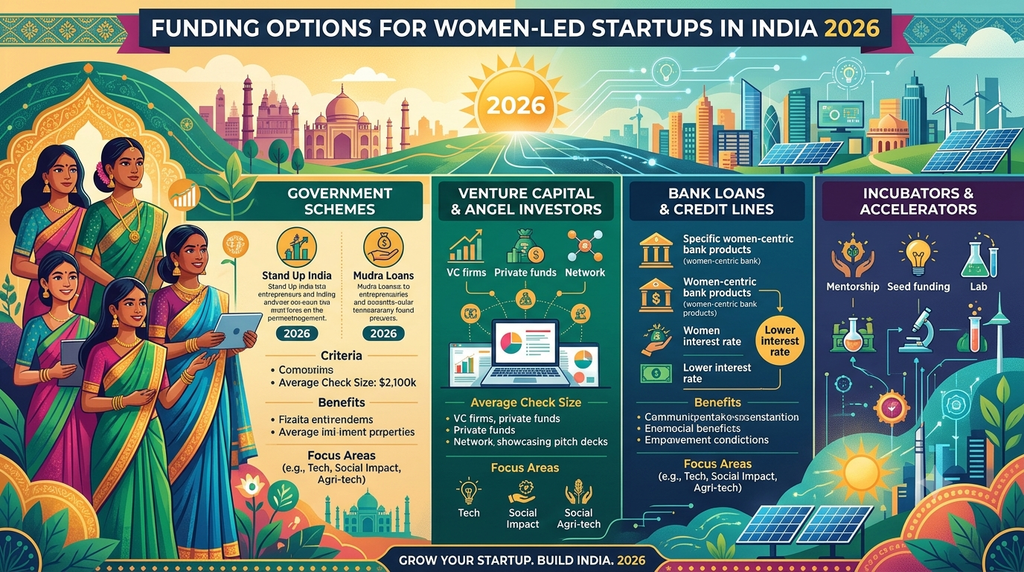
Funding options for women-led startups in India include government-backed schemes, incubator support, credit guarantees, bank loans and investment funds.
Starting a business can feel exciting, but finding money to turn an idea into reality can be tough. For women founders, support is not only about money. It is also about building trust with lenders and managing business expenses, which makes the journey harder in many ways.
When startup funding slows down after 2026, women founders may need to explore other sources of support. They cannot rely on investors alone. In India, government-backed schemes can help women-led startups at different stages.
1. 7 Powerful Funding Options for Women-Led Startups in India
A new business often needs money before it starts earning. It may need funds to build a product, test an idea or enter the market. The Startup India Seed Fund Scheme (SISFS) was created to help early-stage startups through approved incubators. It can support proof of concept, prototype development and product trials.
Founders of early-stage startups can look for participating incubators and check whether funding is currently available. The scheme does not promise funding to every applicant, but it remains a useful option for early support.
2. Fund of Funds for Startups
Some women-led startups need money to grow. They may want to expand operations, hire people or reach new markets. The Fund of Funds for Startups (FFS) gives capital to investment funds, which then invest in startups, including women-led ones. The government does not give money directly to founders under this program.
Founders who want equity investment should research the funds that the government supports and check whether their business fits the investment criteria. This route can be helpful for growing startups.
3. Credit Guarantee Scheme for Startups
Not every founder wants to give up ownership. Some prefer to borrow money and keep control of their business. The Credit Guarantee Scheme for Startups (CGSS) helps with startup debt through participating institutions. The government guarantee helps lenders manage some of the risk, which makes formal loans easier to obtain.
A credit guarantee is neither a grant nor a loan waiver. Founders must still repay the loan, and approval depends on the lender’s review and the scheme’s conditions. Even so, it is a good option for those who want to keep ownership.
4. MUDRA and PMEGP
Not every women-owned business is a startup. Some are manufacturing units, food businesses or tailoring services, and others are small service enterprises. These businesses also need support.
Under the Pradhan Mantri MUDRA Yojana (PMMY), eligible micro and small businesses can get credit through participating lenders, provided they meet the loan category and other conditions.
The Prime Minister’s Employment Generation Programme (PMEGP) is another choice. It offers a margin-money subsidy linked to bank finance, and women entrepreneurs can qualify. Subsidy rates and contribution requirements vary by business type, so it is important to check the guidelines before applying.
5. How Should Women Founders Choose?
The first step is to understand how much money the business actually needs and how that money will be used.
Before applying, women founders should:
– Prepare a business plan and estimate expenses.
– Keep registration, identity and financial documents ready.
– Check eligibility, deadlines and application procedures on official portals.
– Compare loan repayment obligations with equity funding.
– Explore incubators, mentorship programs and state-level startup initiatives.
A funding slowdown can make fundraising harder. However, it can also push founders to explore new paths and plan their expenses more carefully.
Conclusion
I believe founders should not assume that private investors are the only option. Government-backed schemes, incubators, bank loans and investment funds may all provide alternatives. The right choice depends on the business and where it is in its journey.
The best funding option is the one that matches the startup’s needs and fits the eligibility criteria. It must also suit the founder’s ability to manage the money responsibly.
Women-led businesses planning to expand into international markets can also explore MSME export schemes to understand available support for export credit and global market access.
References
[1] Startup India, “Startup Schemes Playbook.” [Online]. Available: https://www.startupindia.gov.in/content/dam/startupindia/homebanners/Startup-Schemes-Playbook-June-2026.pdf
[2] Press Information Bureau, Government of India, “Government Supports Startup Ecosystem Through Three Flagship Schemes Under Startup India Initiative,” Dec. 12, 2025. [Online]. Available: https://www.pib.gov.in/PressReleasePage.aspx?PRID=2202984
[3] Ministry of Micro, Small and Medium Enterprises, Government of India, “Prime Minister’s Employment Generation Programme.” [Online]. Available: https://www.kviconline.gov.in/pmegpeportal/
Reports
Grammar report
AI report
Plagiarism report