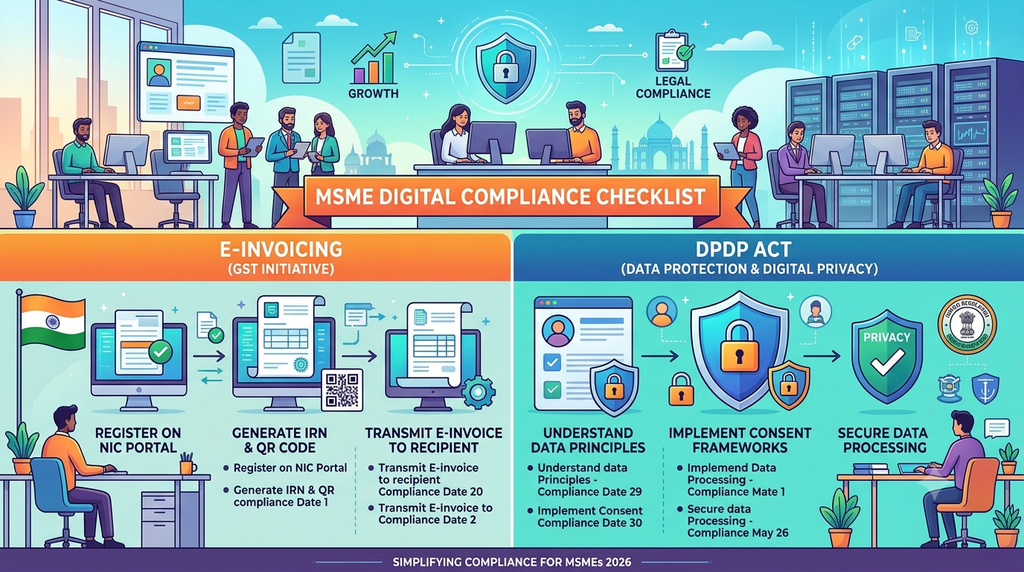
MSME digital compliance involves following GST e-invoicing rules, protecting customer information under the DPDP framework, and maintaining accurate digital business records.
Let’s talk about business. Running a business is not only about selling products or earning money. A small business owner also has to manage invoices, keep customer data safe and follow rules. As more parts of the business move online, digital compliance becomes a must for every MSME.
1. 7 Essential MSME Digital Compliance Checks for E-Invoicing and DPDP
E-invoicing under GST means sending invoice details to the Invoice Registration Portal (IRP). The IRP then creates an Invoice Reference Number (IRN) and a QR code for every invoice.
Not every business is required to do e-invoicing. It usually applies to registered taxpayers whose total annual turnover reached five crore rupees or more in any year from 2017-18 onward, unless exemptions apply.
MSME e-invoicing checklist:
– Check turnover across all GST registrations linked to the MSME’s PAN.
– Find out if the MSME falls under the e-invoicing rule or is exempt.
– Make sure billing software can create invoices in the required format.
– Get the IRN and QR code from the IRP for every invoice that needs them.
– Store invoice files neatly, and make sure invoice data matches accounting and GST records.
Following these steps can reduce mistakes and make handling invoices simpler. MSME owners should check their e-invoicing status on the GST e-portal. Do not assume that being an MSME means the business is free from e-invoicing rules.
2. DPDP Act: Protecting Customer Information
Let’s think about a business that collects customer names, phone numbers, email addresses and delivery addresses. What if this data is shared without permission? It could be seen by someone who should not have it.
This is why the Digital Personal Data Protection (DPDP) Act, 2023 matters. The DPDP Rules, 2025 were announced in November 2025 and will be applied in phases.
The rules explain how digital personal data is collected, used, stored and protected. The exact duties and deadlines depend on the rules and the role of the business.
MSME data protection checklist:
– List the data the MSME collects.
– Collect only the data that is needed for a clear reason.
– Explain clearly how personal data will be used, and get permission when required.
– Allow only authorised staff to access customer data.
– Use security measures like passwords and access control.
– Set up a process to handle data breaches and customer requests.
– Check the DPDP deadlines and rules that apply to the MSME.
These steps can help MSMEs get ready for their obligations and build trust with their customers.
3. A Simple Digital Compliance Routine
Compliance does not have to be a burden. MSMEs can use a checklist to store invoices, keep customer records, check who has access and ask an expert when rules are unclear.
A small business should remember that e-invoicing and data protection are separate duties. Doing one does not mean the other is done.
Digital compliance may seem difficult for MSMEs with limited staff and resources. However, knowing the rules can help, and making a checklist can make things easier.
Conclusion
In my opinion, compliance should not be seen as just paperwork. Correct invoicing keeps records clean, and careful handling of data builds trust. Both are important for running a business in today’s world.
Along with e-invoicing and data protection, businesses should understand GST compliance for SMEs to maintain accurate tax records and meet applicable reporting requirements.
References
[1] Goods and Services Tax Network, “E-Invoicing FAQs.” [Online]. Available: https://www.gstn.org.in/faqs-category-details
[2] Ministry of Electronics and Information Technology, Government of India, “Digital Personal Data Protection Rules, 2025.” [Online]. Available: https://www.meity.gov.in/documents/act-and-policies/digital-personal-data-protection-rules-2025-gDOxUjMtQWa?pageTitle=Digit
Reports
Grammar report

AI report
Plagiarism report