
Source: ChatGPT (OpenAI)
The IGST Section 13 amendment changes how the place of supply is determined for intermediary services, potentially helping eligible Indian businesses qualify for export treatment when providing services to foreign clients.
For instance, a Delhi-based agency may link a company in the UK with suppliers in India and get a commission for every deal. The agency considers their service as an ‘export’ as their client is in the UK. But under the old GST rules for ‘place of supply’, the place of supply of intermediary services could be deemed to be in India even if the customer was outside India.
This made it possible for Indian GST to be applicable on the agency and it was difficult to qualify for ‘export’ treatment. After all, if the client is outside India, what is the liability of the service for GST in India?
IGST Section 13 Amendment: When Can Intermediary Services Qualify as Exports?
Under GST, “intermediary services” means services in which a person or business arranges or facilitates a supply between two or more parties. For example, an Indian commission agent may introduce a foreign company to an Indian manufacturer and earn a commission when the deal is done.
In contrast, if an Indian company supplies IT support service or designs the website directly to a foreign client, it is the supply of its own service and not necessarily an “intermediary service”. The fact that someone is called an “agent” or “consultant” in the contract does not automatically mean that is how they will be classified. You have to examine the actual role, the terms of the agreement, and the nature of the service provided.
Why did old IGST Section 13 create a problem?
The general rule under Section 13 of the IGST Act which stated that the place of supply is the location of the recipient was applicable for cross-border services. However the section 13(8)(b) created a special exception for intermediate services where the location of the supplier is the place of supply.
If an Indian intermediary was providing services to a foreign client, even if the client was based outside India, then the place of supply could be considered to be India. For a service to qualify as an ‘export of services’, the place of supply should be outside India.
This special rule would not allow intermediary services to be treated as exports and could put a GST burden on Indian businesses. This also had the potential to lead to disputes about tax treatment, refunds and service classification.
What changes after the amendment?
Finance Act, 2026 has omitted special rule on ‘place-of-supply’ for intermediary services under section 13(8)(b) of IGST Act. Post this amendment, the place of supply of intermediary services is generally determined by the default rule under Section 13(2) which means that the place where the service recipient is located is the deciding factor.
For instance, a Delhi-based agency that connects a firm in the UK with Indian suppliers and earns a commission. Earlier, with the help of a special rule, the place of supply could have been treated as India. With this amendment, if the UK company is the recipient of the service, the place of supply may be UK now. This could increase the likelihood of the service qualifying as an ‘export of services’.
However, it does not mean that any service provided to a foreign client is an export. The other legal requirements for ‘export of services’ must also be fulfilled. This change is effective March 30, 2026; transactions prior to that date are to be evaluated under the rules in effect at the time of the transaction.
Does this mean every intermediary service becomes GST-free?
No, amendment does not mean that all intermediary services have automatically become GST free. The relevant export conditions must be fulfilled for a service to be an export.
The business must also look at whether it is enabling a supply between other parties or supplying the service itself. The fact of the transaction is that Indian businesses are getting services from foreign intermediaries, liability to GST and reverse charge in India may arise.
Therefore, the final tax treatment will depend on the recipient, the supplier, the nature of the service and the applicable rules.
Businesses providing services to overseas clients should review the GST export rules to determine whether their transactions meet the conditions for export treatment.
Reference:
[1] S. Baheti and A. Gandhi, “Intermediary Services under GST: Impact of Amendment on Cross-Border Transactions and Transitional Challenges,” Bizsolindia, Apr. 2026. [Online]. Available: https://www.bizsolindia.com/article-on-intermediary-services-under-gst-impact-of-amendment-on-cross-border-transactions-and-transitional-challenges-by-ca-siddhi-baheti-ca-anuj-gandhi-april-2026/.
[2] APMH Consulting, “Intermediary Services: Game-Changing GST Amendment,” APMH Consulting. [Online]. Available: https://apmhconsulting.com/insights/APD-008_Intermediary_Services_GST_Amendment.
[3] Mittal & Co., “Place of Supply Rule for Intermediary Services: 2026 GST Change,” CA Mittal. [Online]. Available: https://camittal.com/place-of-supply-rule-for-intermediary-services-2026/.
Plagiarism Report:

Grammar Report:

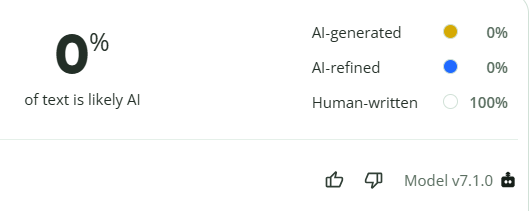
AI Report: