
A Guide to Choosing Between Wholesale and Retail Business Models
Published: Oct 11, 2026
Key Highlights
- Wholesale vs Retail Business Models: Wholesale businesses sell goods in bulk, typically to retailers or other businesses, while retail businesses sell products directly to final consumers.
- GST Registration: Both wholesale and retail businesses must assess GST registration requirements based on applicable turnover thresholds, business activities, and statutory conditions.
- Invoicing Requirements: Wholesalers and retailers must issue appropriate tax invoices or bills of supply, depending on their GST registration status and the nature of their transactions.
- GST Compliance: Wholesale vs retail operations may involve different transaction volumes, customer types, and recordkeeping needs, but both must follow applicable GST rules.
- Pricing and Profit Margins: Wholesalers generally rely on bulk sales and lower per-unit margins, whereas retailers often charge higher per-unit prices to cover operating expenses.
- Input Tax Credit: Eligible GST-registered businesses may claim input tax credit subject to statutory conditions and documentation requirements.
Wholesale vs retail refers to two different business models with distinct pricing strategies, customer bases, and sales processes. Wholesalers typically sell goods in bulk to retailers or other businesses, while retailers sell products directly to consumers. Understanding wholesale vs retail helps businesses compare profit margins, inventory requirements, GST obligations, invoicing rules, and compliance responsibilities. This article explains the key differences between wholesale and retail businesses and the important regulatory considerations entrepreneurs should understand before choosing a business model.
Index Terms— Tax audit report, filing deadline, Section 44AB, Form 3CA, Form 3CB, Form 3CD, income-tax compliance.
I. INTRODUCTION
Tax audit report due date 2026 is an important compliance deadline for eligible taxpayers under Section 44AB of the Income-tax Act, 1961. Tax audit requirements aim to improve the accuracy and reliability of financial information reported to the Income Tax Department. Specified taxpayers carrying on a business or profession must have their accounts audited by a qualified accountant and submit the prescribed audit report within the applicable deadline.
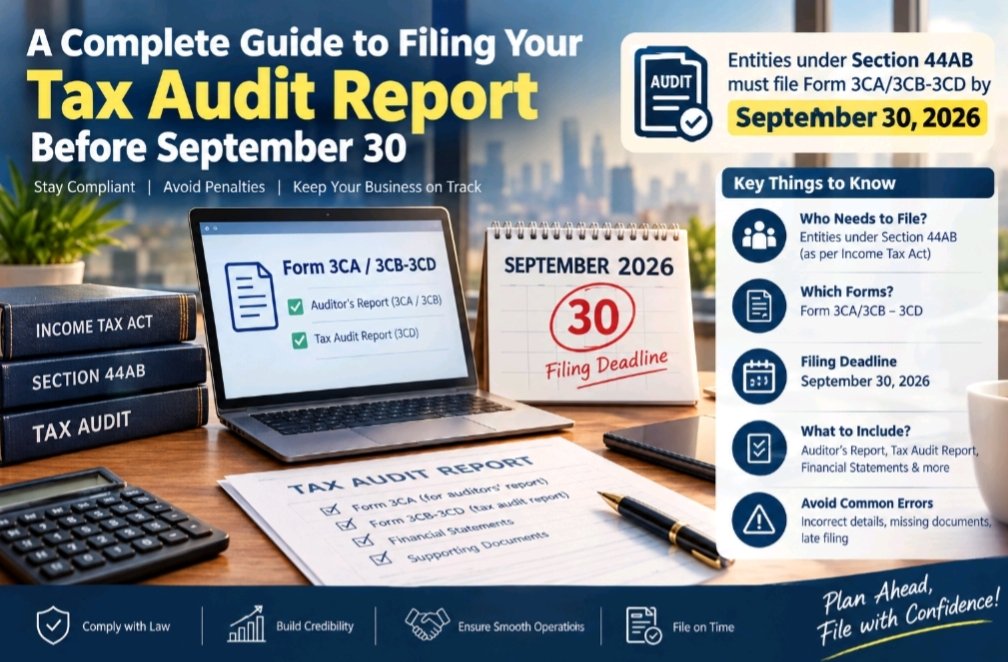
Tax audit report due date 2026 is September 30, 2026, for applicable taxpayers for AY 2026–27 whose corresponding income-tax return is due on October 31, 2026. The Income Tax Department has clarified that taxpayers must use the existing Form 3CA, Form 3CB, and Form 3CD under the Income-tax Act, 1961 for FY 2025–26 [1], [2].
II. WHO GENERALLY NEEDS A TAX AUDIT?
The tax-audit requirement applies to specified persons whose business or professional income meets the conditions prescribed under Section 44AB. The Income Tax Department’s current guidance notes the following broad thresholds under the corresponding provisions:
• Business: total sales, turnover, or gross receipts exceeding ₹1 crore, subject to the higher ₹10 crore threshold where cash receipts and cash payments do not exceed the prescribed 5% limits.
• Profession: gross receipts exceeding ₹50 lakh
• Certain taxpayers who opt out of presumptive taxation or declare income below prescribed presumptive-taxation limits may also become subject to audit, depending on the applicable conditions.
The applicability of audit depends on the taxpayer’s exact facts and the conditions of the law. Therefore, taxpayers should have the position reviewed by a qualified tax professional rather than relying only on the turnover threshold [1].
III. UNDERSTANDING FORM 3CA, FORM 3CB AND FORM 3CD
For AY 2026–27, the Income Tax Department provides two principal combinations of forms for tax-audit reporting.
A. Form 3CA-3CD
Form 3CA is used where the taxpayer’s accounts have already been audited under another law. Form 3CA contains the audit report, while Form 3CD contains the statement of prescribed particulars required under Section 44AB [3].
B. Form 3CB-3CD
Form 3CB is generally used for taxpayers whose accounts are not required to be audited under another law but who are required to obtain a tax audit under Section 44AB. Form 3CD accompanies Form 3CB and contains the prescribed tax particulars [4].
C. Form 3CD
Form 3CD is the detailed statement of particulars accompanying either Form 3CA or Form 3CB. It requires information relating to accounting records, tax deductions, depreciation, payments, loans and other prescribed matters. The information should be reconciled carefully with the taxpayer’s books and supporting records.
IV. THE SEPTEMBER 30, 2026 FILING DEADLINE
Tax audit report due date 2026 is September 30, 2026, for applicable AY 2026–27 cases where the income-tax return is due on October 31, 2026. According to the Income Tax Department’s FAQ, the audit report for FY 2025–26 must be filed under the Income-tax Act, 1961 using the prescribed Form 3CA-3CD or Form 3CB-3CD. The deadline is one month before the corresponding income-tax return due date [2].
The Department also issued an e-filing reminder on September 22, 2026 advising taxpayers to file Form 3CA-3CD or 3CB-3CD for AY 2026–27 by September 30, 2026 to avoid a last-minute rush [5].
V. STEP-BY-STEP PROCESS FOR FILING
1) Determine audit applicability: Review turnover, gross receipts, presumptive-taxation provisions, cash transactions, and other relevant conditions.
2) Finalise the books: Ensure that the books of account are complete and that the profit and loss account and balance sheet reconcile with underlying records.
3) Appoint the accountant: The taxpayer assigns the eligible Chartered Accountant through the income-tax e-filing system for the applicable audit report.
4) Select the correct form: Use Form 3CA when the accounts have been audited under another law; otherwise, Form 3CB generally applies. Form 3CD accompanies both.
5) Prepare supporting information: Reconcile turnover, expenses, depreciation, tax deductions, loans, related-party transactions, GST information where relevant, and other prescribed particulars.
6) Review Form 3CD: The taxpayer and auditor should check the particulars against the books, financial statements, tax records, and supporting documentation.
7) Submit electronically: The Income Tax Department provides an online filing process and an offline utility/JSON route for Form 3CA-3CD and Form 3CB-3CD [3], [4].
8) Complete the taxpayer’s ITR: After the audit report is furnished, the taxpayer should ensure that the income-tax return is prepared consistently with the audited information and filed by its applicable due date.
VI. DOCUMENTS AND INFORMATION TO KEEP READY
A smooth filing process depends on timely preparation of supporting records. Common information includes:
• Audited financial statements and trial balance.
• General ledger and relevant schedules.
• Sales and purchase registers.
• Bank statements and cash records.
• Details of depreciation and fixed assets.
• Details of loans, deposits, repayments, and specified payments.
• TDS/TCS information and relevant tax statements.
• GST returns and reconciliations, where applicable.
• Details required for deductions, disallowances, and other Form 3CD clauses.
• Details of related-party transactions and specified transactions, where applicable.
The exact information required can vary with the taxpayer’s business or profession and the clauses applicable to the audit report.
VII. COMMON ERRORS TO AVOID
Several avoidable errors can delay completion or create inconsistencies between the audit report and the income-tax return.
A. Turnover mismatch: Sales reported in the books should be reconciled with GST records and other relevant data.
B. Incorrect tax particulars: Information relating to deductions, disallowances, depreciation, TDS/TCS, and other tax items should be checked against source records.
C. Incomplete disclosures: Required Form 3CD particulars should not be left unsupported or incorrectly classified.
D. Last-minute filing: Waiting until the final day can create practical problems if information, approvals, portal access, or corrections are required.
E. Mismatch with the ITR: Figures reported in the tax audit report should be consistent with the income-tax return, subject to legitimate differences that are properly explained.
VIII. WHY EARLY FILING MATTERS
Early preparation provides time to identify discrepancies and obtain clarifications from the accountant. It also allows businesses and professionals to reconcile their books, GST information, tax deductions, and financial statements before the final submission.
For businesses with complex transactions, multiple locations, substantial inventory, or significant related-party activity, early coordination between the accounts team and the tax auditor can reduce the risk of avoidable errors. It also leaves time to address technical or documentation issues before the filing deadline.
IX. TRANSITION TO THE INCOME-TAX ACT, 2025
A key point for AY 2026–27 is that the tax audit report for FY 2025–26 remains governed by the Income-tax Act, 1961. The Income Tax Department has clarified that the existing Form 3CA, Form 3CB, and Form 3CD are used for this assessment year.
For Tax Year 2026–27 under the Income Tax Act, 2025, the Department has stated that a new Form 26 will replace the earlier combination of Forms 3CA, 3CB, and 3CD, with the tax-audit report due on September 30, 2027 [1]. This distinction is important because taxpayers should select the forms applicable to the relevant financial/assessment year rather than assuming that the new forms apply retrospectively.
X. CONCLUSION
The September 30, 2026 filing deadline is an important compliance date for taxpayers required to furnish a tax audit report for AY 2026–27. Form 3CA-3CD or Form 3CB-3CD must be selected according to the taxpayer’s circumstances, and the information reported should be carefully reconciled with the books of account, financial statements, tax records, and supporting documents.
The most effective approach is to determine audit applicability early, finalise accounts, coordinate with the Chartered Accountant, verify Form 3CD particulars, and complete electronic filing before the deadline. Proper preparation can reduce last-minute errors and help ensure that the tax audit report and subsequent income-tax return are consistent and complete.
Core Regulatory Takeaways-
Wholesale vs Retail Business Models: Wholesale businesses sell goods in bulk, typically to retailers or other businesses, while retail businesses sell products directly to final consumers.
GST Registration: Both wholesale and retail businesses must assess GST registration requirements based on applicable turnover thresholds, business activities, and statutory conditions.
Invoicing Requirements: Wholesalers and retailers must issue appropriate tax invoices or bills of supply, depending on their GST registration status and the nature of their transactions.
GST Compliance: Wholesale vs retail operations may involve different transaction volumes, customer types, and recordkeeping needs, but both must follow applicable GST rules.
Pricing and Profit Margins: Wholesalers generally rely on bulk sales and lower per-unit margins, whereas retailers often charge higher per-unit prices to cover operating expenses.
FAQs
What is the difference between wholesale vs retail?
Wholesale vs retail refers to two different business models. Wholesalers generally sell goods in bulk to retailers or other businesses, while retailers sell products directly to final consumers.
2. Which is more profitable, wholesale vs retail?
Profitability depends on sales volume, operating costs, pricing, competition, and demand. Wholesale businesses typically earn lower margins per unit but sell larger quantities, while retail businesses may earn higher margins per unit.
Statutory Citations & References
Central Board of Indirect Taxes and Customs, Government of India, “Sectoral FAQs—GST Registration,” official website.
Goods and Services Tax Portal, Government of India, “Apply for Registration—Normal Taxpayer,” official user guide.
Central Board of Indirect Taxes and Customs, Government of India, “Tax Invoice, Credit and Debit Notes,” official invoice rules.
Central Board of Indirect Taxes and Customs, Government of India, “Input Tax Credit Rules,” official guidance.
Maximize Your Business Potential
Looking for a partner to advise on GST, ITR, Business Registration, or Financial Strategy? Our experts ensure your compliance is seamless and your solutions are optimized.
Book a Strategy ConsultationEve Finance: Your Daily Financial Eve-olution!
Finance made simple, fast, and fun! 🏦💡 Sign up for your daily dose of financial insights delivered in plain English. In just 5 minutes, you’ll be smarter and better!