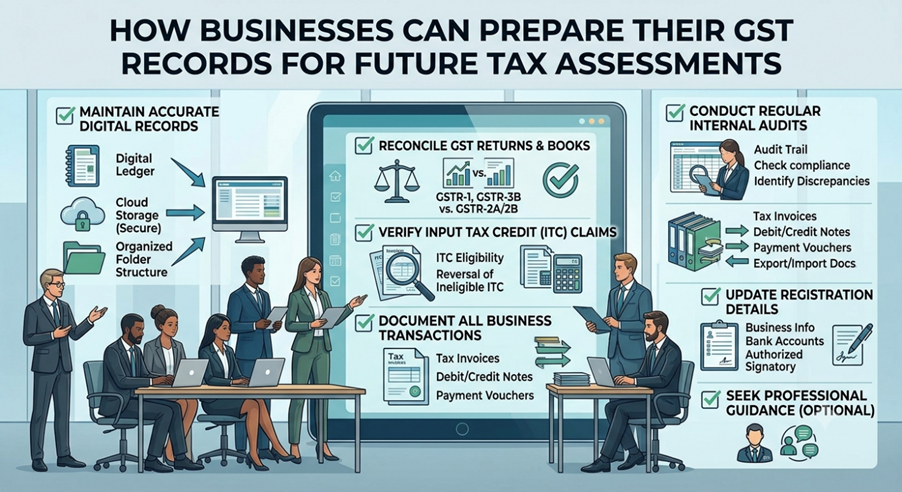
GST Records for Tax Assessment It almost always turns up on a normal Tuesday, addressed to a financial year you haven’t thought about. The accountant who filed those returns left 18 months ago. The ERP was migrated. The supplier whose invoice you are querying has shut down. Somewhere in a shared drive, in a folder no one has looked at since the migration, is the one document that will end the matter in a paragraph.
That lack – the time between what happened and the time you can still prove what happened – is the risk. It isn’t the tax. The tax is almost certainly justifiable. What your business loses in hearings is rarely the argument; it is the evidence. The timeline is longer than most expect, Books of account and related records, under section 36 of the CGST Act, 2017, must be retained for 72 months after the due date of the corresponding annual return – and longer if an appeal, review or investigation is still pending, at which point they must be kept for a year after completion. GST Records for Tax Assessment
GST Records for Tax Assessment: Build files, not folders.
Most businesses file documents by type: all invoices in one place, all bank statements in another, all e-way bills in yet another. That works well for filing, not well for defending. Departmental queries are almost never about a category. They are about a transaction. A notice seeking clarification under section 61 – issued in Form ASMT-10, with thirty days to respond in ASMT-11 – will specify the inaccuracies: input tax credits taken against a supplier who didn’t file GSTR-3B, values in GSTR-1 that don’t match e-invoices. These e-way bill movements are greater than the reported outward supply. That means bringing together, for just one invoice, a full trail: the purchase order or agreement, the tax invoice, evidence the supply happened (e-way bill, transporter documentation, gate or goods inward entry), proof of the payment by banking channels, and the credit’s path through GSTR-2B and your books. Add the 180-day payment time frame under the second proviso to section 16(2), and the section 16(4) deadline to take advantage of the credit, and a single line item may require six or seven files from four systems.
Reconcile monthly – the system now does, The Invoice Management System has changed the shape of this work. Since a mandated part of the monthly process from April 2026, GSTR-2B isn’t a statement provided to you – it is a result of your decisions on the portal. Accepting, rejecting, or holding an invoice is a recorded act, and you can replay it later. That works both ways. Rejecting a bad invoice in IMS forces the supplier to put it right while the parties are still engaged, and the facts are fresh in everyone’s mind. So the monthly reconciliation – purchase register to IMS to GSTR-2B, outward supply to e-invoices to e-way bills, GSTR-1 to GSTR-3B – isn’t proper bookkeeping; it’s the lowest-cost version of the work you’ll otherwise end up doing under pressure and three years late from recall. GST Records for Tax Assessment
Write down why, not just what, This is the part that almost no one does, and this is the part that matters most. Every business makes judgement calls: a classification decision, a related-party cost valuation method, a place-of-supply decision, an ITC apportionment under Rule 42/43, a decision that one cost qualifies as an expense. At the time, the assumption is clear. Four years later, it isn’t. A brief note to go with it – one page, dated, clearly spelling out the decision made, the facts relied upon, the cited rule or circular, and who approved it – is worth disproportionately more. It turns an apparently arbitrary error into a documented position taken in good faith. Since section 74A retains the fraud exception for penalty calculation even if it has been removed from notice periods, the distinction between one position and another oversight is worth a lot of money. Good documentation means less tax review risk – and no one can demonstrate it better than a file that explains itself. GST Records for Tax Assessment
GST Records for Tax Assessment: Make the records searchable.
Electronic records are allowable, subject to proper authentication, backups, and the ability to access file passwords on demand. But reality falls apart in three ways. Some data gets stuck in older systems after migration and becomes today-preserved, but practically unavailable. Approvals are locked away in people’s email inboxes, which are deleted when the person leaves. And the audit trail – who changed what and when – is disabled or replaced. GST Records for Tax Assessment
A good test: pick a random invoice from two financial years ago and have someone else produce it in its entirety. Give them an hour. Anything they can’t produce is the business you won’t have when you need it. Rehearse it before anyone else needs to GST Records for Tax Assessment
Do an internal sampling audit each year, checking some transactions against the same comparison tools the portal uses. Think of it as real-time free intelligence rather than a private fault-finding mission.
GST Records for Tax Assessment: The quiet advantage
A form of tax compliance that is solely defensive is, frankly, exhausting. But businesses that keep their records this way tend to notice a different thing: they close their books faster; they identify supplier issues before they become unresolvable; and they can meet a banker or potential acquirer’s due diligence requirements without a panic. GST Records for Tax Assessment
The file you prepare for a future GST audit is also the file that will tell you whether you are actually doing well. That makes an unglamorous habit something that pays back. GST Records for Tax Assessment
References
- Section 36, CGST Act, 2017 — Period of retention of accounts. Central Board of Indirect Taxes and Customs. https://taxinformation.cbic.gov.in/content/html/tax_repository/gst/acts/2017_CGST_act/active/chapter8/section36_v1.00.html
- Section 61, CGST Act, 2017 — Scrutiny of returns; Rule 99 and Forms ASMT-10, ASMT-11, ASMT-12. https://taxreply.com/gst-act-and-rules/Section-61-of-CGSTACT
- Section 61 of GST — Scrutiny of Returns: ASMT-10, ASMT-11 & ASMT-12, TaxGuru. https://taxguru.in/goods-and-service-tax/section-61-gst-scrutiny-returns-asmt-10-asmt-11-asmt-12.html
- GST SCN Deadlines — Sections 73, 74 & 74A, Ved Jain and Associates (on the 42-month notice window and 12-month order timeline under Section 74A). https://vedjainassociates.com/knowledge/gst-scn-deadlines
- Section 74A — Unified limitation for demands, TaxTMI analysis of the Finance (No. 2) Act, 2024 amendment. https://www.taxtmi.com/article/detailed?id=13016
- Internal Link: Add Post ‹ Eve Consultancy — WordPress
AI Detection
Proof reading
Plagiarized