
A Guide to Companies Act Compliance for Private Placement of Shares
Published: Oct 10, 2026
Key Highlights
- Corporate Approvals: Private placement compliance requires companies to obtain the necessary Board and shareholder approvals before proceeding with the offer, as applicable under the Companies Act, 2013.
- Identified Investors: Companies must offer securities to identified persons and comply with the applicable investor limits under Section 42 and Rule 14 of the Companies (Prospectus and Allotment of Securities) Rules, 2014.
- Form PAS-4 Documentation: Private placement compliance includes preparing and issuing the prescribed private placement offer-cum-application letter to the identified investors.
- Banking Transactions: Subscription money must be received through permitted banking channels, not in cash, in accordance with applicable legal requirements.
- 60-Day Allotment Deadline: Companies must allot securities within 60 days of receiving application money. If allotment does not occur, the money must generally be refunded within the following 15 days.
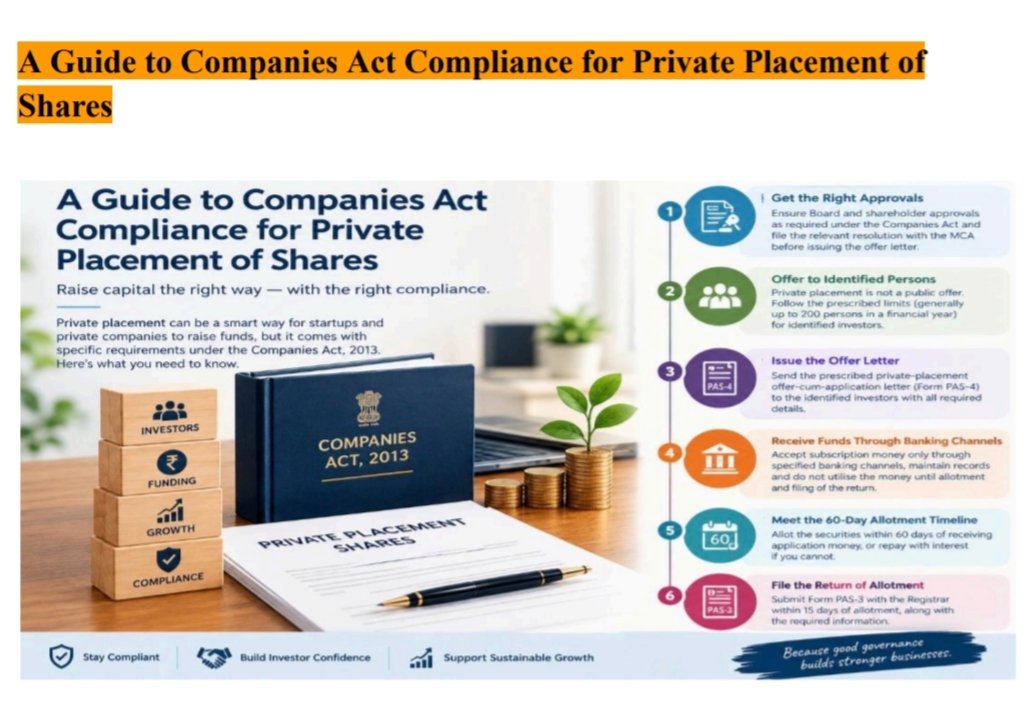
Private placement compliance is essential when a startup raises funds from selected investors under the Companies Act, 2013. Although private placement avoids a public offer, companies must follow specific rules for approvals, investor limits, offer documents, allotment timelines, and regulatory filings. Proper compliance helps startups reduce legal risks and complete fundraising smoothly.
For startups and growing private companies, a missed approval, incorrect documentation or delayed filing can create unnecessary compliance problems. This is why having a proper private-placement checklist is useful before the fundraising process begins. From identifying investors to issuing the offer letter, receiving subscription money and filing the return of allotment, each stage needs to be handled carefully.
1. Start With the Right Corporate Approvals
Before approaching investors, the company needs to establish that the proposed issue has been properly authorised. Section 42 of the Companies Act, 2013 governs private placement, while the applicable rules prescribe additional procedural requirements. The company should therefore review its Articles of Association, determine whether the proposed issue is permitted, and obtain the necessary Board and shareholder approvals before moving ahead.
For many private-placement issues, a special resolution of the members is an important part of the process, although the exact approval requirements can depend on the type of security and circumstances of the issue. The resolution and related corporate records should be prepared carefully because the fundraising process should not begin with investors before the required approvals are in place. The MCA rules also require the relevant resolution to be filed with the Registry before the private placement offer-cum-application letter is issued.
2. Private Placement Means Offering Securities to Identified Persons
One of the defining features of private placement is that the company is not making a general invitation to the public. Section 42 requires the offer to be made to identified persons within the prescribed limits and conditions. Under Rule 14 of the Companies (Prospectus and Allotment of Securities) Rules, 2014, the offer is generally restricted to not more than 200 persons in aggregate in a financial year, subject to the specified exclusions and conditions. The calculation is made separately for each kind of security, such as equity shares, preference shares, or debentures.
Private placement compliance requires startups to review their proposed investor list carefully before making an offer. Under the Companies Act, 2013, private placement is subject to specific investor limits and eligibility requirements. Companies should verify the applicable rules before approaching investors to reduce the risk of non-compliance and avoid delays in fundraising.
3. The Private Placement Offer Letter Needs Attention
Once the identified investors and approvals are in place, the company needs to issue the prescribed private-placement offer-cum-application letter, generally in Form PAS-4. This is not merely a routine application form. The prescribed format contains important information about the company and the proposed issue, including details relating to the offer, financial position and relevant corporate information.
Private placement compliance requires companies to issue the offer and application form specifically to the identified investor. Under the applicable rules, the private-placement application cannot be treated as a general subscription form or freely circulated to other potential investors. Startups should establish clear procedures for preparing, addressing, and distributing offer documents to avoid procedural errors and maintain compliance throughout the fundraising process.
4. Keep the Money Trail Clear
Fundraising compliance does not end once an investor transfers money. Section 42 requires subscription money to be paid through specified banking channels rather than cash, and the company must maintain the relevant records. The rules also require the company to keep track of the bank account from which subscription payments are received, subject to the applicable exceptions.
Private placement compliance requires companies to follow the prescribed sequence before using funds raised from investors. Under Section 42 of the Companies Act, 2013, the company must not utilise the money until it has made the allotment of securities and filed the return of allotment with the Registrar. Startups should therefore plan their fundraising timelines carefully and avoid treating subscription money as immediately available working capital.
5. Watch the 60-Day Allotment Timeline
Private placement compliance requires startups to follow strict allotment and repayment deadlines under Section 42 of the Companies Act, 2013. Securities must generally be allotted within 60 days of receiving the application money. If the company fails to allot the securities within this period, it must repay the money within the next 15 days. Failure to repay within that timeframe may trigger statutory interest obligations. Startups should track these deadlines carefully to avoid financial and regulatory consequences.
Private placement compliance is easier to manage when companies plan the entire fundraising process before accepting subscription money. Startups should coordinate Board meetings, shareholder approvals, offer documentation, securities allotment, and MCA filings as part of one structured process. Advance planning helps prevent missed deadlines, reduce procedural errors, and ensure that each stage of fundraising is completed in the correct sequence.
6. PAS-3 Filing Is an Important Closing Step
Private placement compliance continues even after securities are allotted. Under Section 42 of the Companies Act, 2013, companies must complete the prescribed regulatory filings within the required timelines.
A key requirement of private placement compliance is filing the return of allotment in Form PAS-3 with the Registrar of Companies within 15 days of allotment. For effective private placement compliance, the filing must include the prescribed information, including details of the allottees and the securities allotted. Startups should make private placement compliance a priority by tracking filing deadlines, maintaining accurate allotment records, and ensuring that all required documents are submitted correctly.
Following a structured private placement compliance checklist can help companies reduce procedural errors and meet their legal obligations during fundraising.This filing is more than a formality. It creates an official record of the securities issued through the transaction. The company should therefore ensure that the information in PAS-3 matches its underlying corporate records, investor documentation, and allotment resolutions.
7. Avoid Treating Compliance as an Afterthought
The biggest mistake a startup can make is to think about compliance only after the money has arrived. By that stage, correcting an incorrect investor list, missing approval or delayed filing can become much more complicated.
Private placement works best when legal, finance and company-secretarial processes are coordinated from the beginning. The company should maintain a clear transaction file containing approvals, investor details, offer documents, subscription records, valuation documentation where applicable, allotment records and MCA filings. This creates a clear audit trail and makes it easier to demonstrate that the fundraising process was completed in accordance with the applicable requirements.
There is also a broader lesson for founders. Raising capital is naturally focused on valuation, investors, dilution, and growth, but the legal structure of the fundraising should receive the same attention. A funding round is not complete merely because the company has received the money. The transaction is complete only when the required corporate and regulatory steps have also been properly addressed.
Bottom Line
Private placement can provide startups and private companies with an important route for raising capital, but it comes with a structured compliance process under the Companies Act, 2013 and applicable rules. Investor identification, corporate approvals, PAS-4 documentation, payment records, allotment timelines, and PAS-3 filing are all pieces of the same process.
The safest approach is not to treat these requirements as paperwork to be completed at the end. Instead, companies should build compliance into the fundraising plan from day one.
Because when a startup is raising capital, getting the money is only one part of the job. Getting the paperwork, approvals, timelines, and records right is what helps make the fundraising process complete.
Statutory Citations & References
[1] Ministry of Corporate Affairs, Government of India, The Companies Act, 2013, Section 42 – Issue of shares on private placement basis. India Code – Companies Act, 2013
[2] Ministry of Corporate Affairs, Government of India, Companies (Prospectus and Allotment of Securities) Rules, 2014 – Rule 14: Private Placement. MCA – Private Placement Rules
[3] Ministry of Corporate Affairs, Government of India, Instruction Kit for Form PAS-3 – Return of Allotment. MCA – Form PAS-3 Instruction Kit
[4] Institute of Company Secretaries of India (ICSI), Companies Act, 2013 – Section 42 and Private Placement Provisions. ICSI – Companies Act Resources
[5] Ministry of Corporate Affairs, Government of India, Companies (Share Capital and Debentures) Rules, 2014 – Issue of Shares on Preferential Basis. India Code – Share Capital and Debentures Rules
Maximize Your Business Potential
Looking for a partner to advise on GST, ITR, Business Registration, or Financial Strategy? Our experts ensure your compliance is seamless and your solutions are optimized.
Book a Strategy ConsultationEve Finance: Your Daily Financial Eve-olution!
Finance made simple, fast, and fun! 🏦💡 Sign up for your daily dose of financial insights delivered in plain English. In just 5 minutes, you’ll be smarter and better!