
How the CCI’s Recent Ruling on Vygon India Affects Market Dominance Cases
Published: Oct 10, 2026
Key Highlights
- Market Dominance Must Be Proven: The CCI ruling highlights that a company's dominant position must be established through evidence relating to the relevant market.
- Restrictive Dealership Practices: The CCI ruling clarifies that dealership restrictions do not automatically constitute a competition-law violation; their impact on competition must be assessed.
- Section 3(4) Compliance: The CCI ruling emphasizes the importance of evaluating vertical agreements and whether they cause or are likely to cause an appreciable adverse effect on competition.
- Section 4 and Abuse of Dominance: The CCI ruling highlights that holding a dominant position is not itself unlawful; the law prohibits the abuse of that position.
- Alternative Suppliers Matter: The availability of alternative suppliers and the ability of dealers to switch can influence the assessment of market foreclosure.
- Evidence Is Essential: The CCI ruling demonstrates the importance of supporting allegations with evidence about market power, competitive constraints, and potential harm to competition.
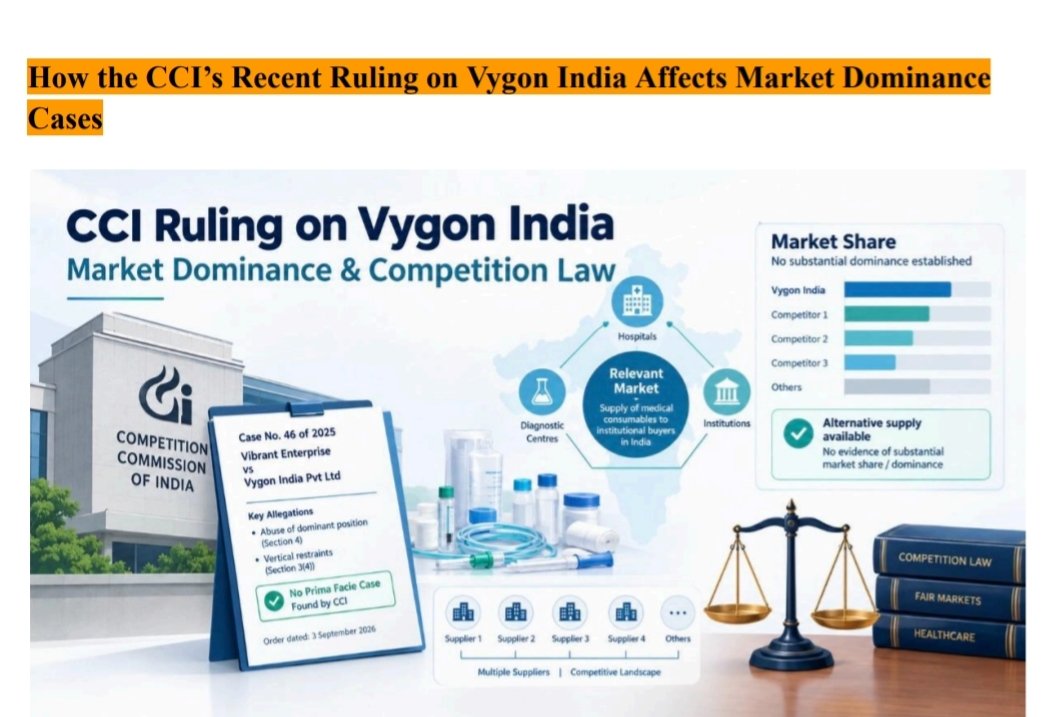
CCI ruling on Vygon India Pvt. Ltd. highlights the importance of proving market dominance and assessing restrictive dealership practices under competition law. On 3 September 2026, the Competition Commission of India (CCI) closed the case after finding no prima facie contravention of Sections 3(4) or 4 of the Competition Act, 2002. The matter involved allegations of restrictive dealership practices and abuse of dominant position. The decision highlights an important principle: alleging that a business practice restricts competition is not sufficient by itself. The relevant market, the enterprise’s market position, and the actual or potential effects on competition must also be considered.
1. What Was the Vygon India Case About?
The case was brought by Vibrant Enterprise, a distributor of medical devices and consumables, against Vygon India. The allegations concerned certain dealership arrangements and were examined by the CCI under provisions relating to vertical restraints and abuse of dominant position.
The issue was therefore not simply whether Vygon had imposed particular conditions on a dealer. The broader competition-law question was whether those practices could amount to a contravention of the Competition Act, considering Vygon’s position in the relevant market and their potential effect on competition. That distinction is important for businesses. A commercial restriction may attract competition-law scrutiny, but the legal assessment depends on the circumstances in which that restriction operates.
2. Market Dominance Has to Be Established
The Commission also considered information regarding other suppliers operating in the medical consumables space. Its order referred to Polymed, HMD and Romsons and noted their presence and resources across relevant product categories. Based on the available material, the CCI did not find that Vygon enjoyed a dominant position in the markets under consideration. This is an important reminder that being a recognised or successful company does not automatically mean that an enterprise is legally “dominant.” Under competition law, dominance is assessed in relation to the relevant market and the competitive constraints faced by the enterprise.
3. Why Market Power Matters for Vertical Restrictions
The case also involved allegations concerning vertical restrictions under Section 3(4) of the Competition Act. Vertical arrangements can include relationships between businesses operating at different stages of the supply chain. The CCI identifies arrangements such as exclusive supply or distribution, refusal to deal, and resale price maintenance among the types of vertical restraints that can be examined under the Act. But does the existence of a restrictive arrangement automatically mean there has been an appreciable adverse effect on competition? Not necessarily. In the Vygon matter, the CCI observed that an entity needs to have some degree of market power for vertical restraints to materially foreclose competition. Because the Commission did not find Vygon to possess the necessary market power, it considered foreclosure of competing suppliers or dealers unlikely on the material before it.
4. Alternative Suppliers Also Became Relevant
Another factor considered by the CCI was the availability of an alternative source of supply. According to the order, after the relationship with Vygon ended, the informant obtained a dealership with Polymed. The Commission considered this an indication that another manufacturer and source of supply was available and that switching at the dealership level was not prohibitive. Why does this matter?
Competition analysis often looks beyond the contract itself. If dealers or customers can realistically switch to alternative suppliers, the ability of a particular business practice to foreclose competition may be different from a situation where meaningful alternatives are unavailable.
5. Dominance Itself Is Not the Same as Abuse
There is another important point businesses should understand. The Competition Act does not prohibit a company simply because it occupies a dominant position. The CCI explains that dominance refers to a position of strength that enables an enterprise to operate independently of competitive forces or affect competitors or consumers in its favour. The concern under Section 4 arises when that dominant position is abused. This distinction is particularly relevant when discussing market-dominance cases. The analysis generally involves asking several questions: What is the relevant market? Does the enterprise hold a dominant position in that market? What conduct is being challenged? And does that conduct amount to abuse within the meaning of the law? The Vygon decision demonstrates why these questions cannot simply be treated as one issue.
6. What Does the Ruling Mean for Businesses?
For businesses operating through distributors, dealers or other supply-chain partners, the decision highlights the importance of understanding how commercial arrangements may interact with competition law. Companies should not assume that a contractual restriction is automatically unlawful, but they should also not assume that contractual freedom places every arrangement outside competition-law scrutiny. The competitive context matters. Market share, availability of competing suppliers, switching possibilities, the structure of the relevant market and the potential effect of the arrangement can all become important when competition concerns are examined.
7. The Bigger Takeaway for Market Dominance Cases
The Vygon India ruling does not establish that all dealership restrictions are acceptable, nor does it mean that every future dominance complaint will be assessed in the same way. The CCI’s conclusion was based on the facts and material available in this particular case. What the decision does show is the importance of building a competition-law case around evidence. In this matter, the CCI concluded that there was insufficient basis to establish Vygon’s dominance and that the alleged vertical restrictions did not, on the available material, cause or have the capability to cause an appreciable adverse effect on competition. The Commission therefore found no prima facie contravention of Sections 3(4) or 4 and closed the information under Section 26(2).
Bottom Line
The Vygon India ruling offers a useful example of how the CCI approaches allegations involving market dominance and vertical restraints. The existence of a commercial restriction is only one part of the analysis. Market definition, market power, alternative sources of supply and the actual or potential impact on competition can all influence the outcome. For businesses, the practical lesson is to look at competition-law issues in their wider market context rather than focusing on a contractual provision in isolation. For parties bringing complaints, the decision also highlights the importance of supporting allegations of dominance and market foreclosure with evidence. Ultimately, competition law is not simply about asking whether a business practice looks restrictive. It is about understanding how that practice operates within the relevant market and whether it produces the kind of competitive harm contemplated by the law.
Core Regulatory Takeaways-
Market Dominance Must Be Proven: The CCI ruling highlights that a company’s dominant position must be established through evidence relating to the relevant market.
Restrictive Dealership Practices: The CCI ruling clarifies that dealership restrictions do not automatically constitute a competition-law violation; their impact on competition must be assessed.
Section 3(4) Compliance: The CCI ruling emphasizes the importance of evaluating vertical agreements and whether they cause or are likely to cause an appreciable adverse effect on competition.
Section 4 and Abuse of Dominance: The CCI ruling highlights that holding a dominant position is not itself unlawful; the law prohibits the abuse of that position.
Alternative Suppliers Matter: The availability of alternative suppliers and the ability of dealers to switch can influence the assessment of market foreclosure.
FAQs
What is the CCI ruling in the Vygon India case?
The CCI ruling concerns allegations of restrictive dealership practices and abuse of dominant position involving Vygon India Pvt. Ltd. The Commission closed the case after finding no prima facie contravention of Sections 3(4) or 4 of the Competition Act, 2002.
Why did the CCI close the Vygon India case?
The CCI ruling fou insufficient grounds to establish that Vygon India held a dominant position in the relevant markets or that the alleged vertical restrictions caused or were likely to cause an appreciable adverse effect on competition.
Statutory Citations & References
[1] Competition Commission of India, “Vibrant Enterprise v. Vygon India Pvt. Ltd., Case No. 46 of 2025,” Order dated September 3, 2026. CCI Antitrust Orders
[2] Competition Commission of India, “Antitrust – Competition Act, 2002.” CCI – Antitrust
[3] LiveLaw, “CCI Finds No Prima Facie Case Of Dominance Abuse Against Vygon India, Closes Information,” September 8, 2026. LiveLaw Business – Vygon India CCI case
Maximize Your Business Potential
Looking for a partner to advise on GST, ITR, Business Registration, or Financial Strategy? Our experts ensure your compliance is seamless and your solutions are optimized.
Book a Strategy ConsultationEve Finance: Your Daily Financial Eve-olution!
Finance made simple, fast, and fun! 🏦💡 Sign up for your daily dose of financial insights delivered in plain English. In just 5 minutes, you’ll be smarter and better!