
ABSTRACT
Looking through the headlines to clear financial signals is essential to understanding a fast-growing, complex country such as India. The article explains five basic economic indicators – Gross Domestic Product (GDP), Consumer Price Index (CPI), Repo Rate, Current Account Deficit (CAD) and the Purchasing Managers’ Index (PMI). These five numbers tell us what’s going fast in India, what’s happening with prices and how sound is the economic edifice is in India.
INTRODUCTION
India’s economy is certainly the fastest growing in the world, but keeping track of what is really going on can seem daunting. Central bank meetings, trade reports and growth data statistics are constantly being cited in news articles. Luckily, it’s not an economics degree required to assess where things are going. Through monitoring these five key economic indicators, we can read the health of the Indian market and make better decisions while saving and running businesses.
THE FIVE KEY ECONOMIC INDICATORS
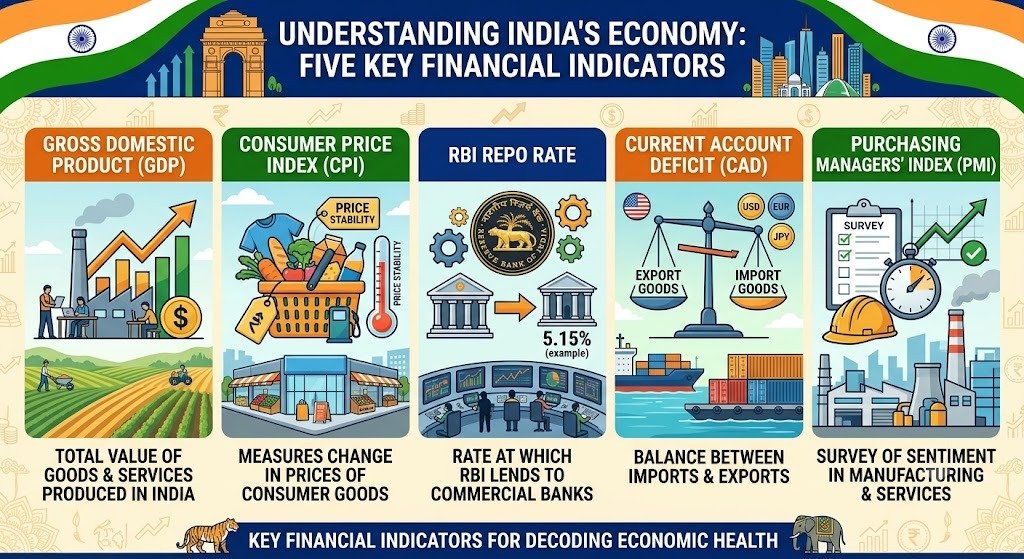
- GROSS DOMESTIC PRODUCT (GDP) GROWTH RATE
GDP is a measure of the total economic value generated by activities that occur within the country. Economic expansion is indicated by a high real GDP growth rate, which indicates growing businesses, job growth, and increased consumption.
- CONSUMER PRICE INDEX (CPI) INFLATION
The CPI, released by the Ministry of Statistics and Programme Implementation (MoSPI), measures price fluctuations for products and services regularly consumed by the population, such as food, fuel and health. Rising inflation reduces the purchasing power of the household and high inflation lowers savings.
- RBI REPO RATE
The interest rate at which Reserve Bank of India (RBI) lends money to commercial banks is termed as repo rate.
When RBI cut rates: Loans for cars, houses and business expansion become more affordable as RBI lowers rates.
When RBI raises rates: It will make borrowing more expensive to curb inflation and spending.
- CURRENT ACCOUNT DEFICIT (CAD)
CAD records the gap between India’s export earnings (from foreign trade) and the import expenditures (such as crude oil imports). A lower deficit means that the rupee is stable and dependency on foreign debt is reduced.
- PURCHASING MANAGER’S INDEX
PMI is a survey of business executives in manufacturing and services industries, conducted once a month. The PMI exceeding 50 is a sign that economy is expanding, providing a preview of GDP trends in the coming months.
CONCLUSION
When you put these five signals together, it makes more sense of the economic news in the headlines. GDP and PMI indicate the growth rate of the economy, while CPI inflation and RBI Repo Rate provide insights into cost of living and interest rates respectively. These are considered along with foreign trade health (CAD), to provide a wholesome picture of India’s eco.
REFERENCES
- Ministry of Statistics and Programme Implementation (MoSPI)
National Accounts Statistics and Consumer Price Index Data
URL: https://www.mospi.gov.in/ - Reserve Bank of India (RBI)
Monetary Policy Statements and Macroeconomic Indicators
URL: https://www.rbi.org.in/ - National Stock Exchange of India (NSE)
Understanding Key Macroeconomic Indicators for Investors
URL: https://www.nseindia.com/learn/content-macroeconomic-indicators - S&P Global Market Intelligence
India Purchasing Managers’ Index (PMI) Overview
URL: https://www.spglobal.com/marketintelligence/en/mi/products/pmi.html