
143 IPO Pipeline Opportunities: India’s $26 Billion Pending Listings Explained
Published: Sep 13, 2026
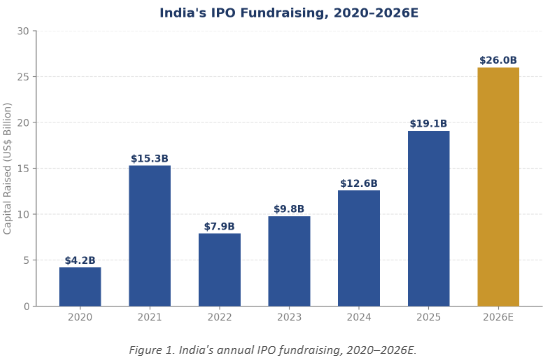
If you’ve glanced at any business headline in India over the past few months, you’ve probably noticed the same word popping up again and again: IPO. Not one or two of them, either. We’re talking about a queue of roughly 143 to well over 200 companies (depending on which tracker you check on a given week), all lined up to knock on the stock market’s door. Somewhere in that queue sits a number that keeps getting quoted at dinner tables and in broker WhatsApp groups alike: $26 billion.
That figure isn’t pulled out of thin air. It’s the rough dollar value of new-issue paper that market watchers expect to hit Dalal Street before this cycle winds down, and honestly, even that might be an undercount. Once you throw in the two elephants everyone’s been waiting for, NSE and Jio Platforms, some estimates balloon past $50 billion. So let’s slow down and actually unpack what’s sitting in this pipeline, why it’s grown so fat, and what it might mean if you’re an investor trying to figure out where to park your money next.
Figure 1. India’s annual IPO fundraising, 2020–2026E.
The Number Everyone’s Quoting, and Why It’s Slippery
Here’s the thing about IPO pipeline estimates: they move constantly, because companies file, withdraw, get SEBI observations, then either launch or sit tight waiting for a better market window. As of the most recent tallies, India’s mainboard pipeline alone had well over 230 companies at various stages, with roughly two-thirds already holding SEBI’s green light (technically called “observations”) and the rest still waiting on the regulator.
Add in the SME platform, where hundreds more smaller issuers file every year, and you get why headline numbers swing wildly depending on who’s counting and what they’re counting. The $26 billion figure tends to refer to the mainboard fundraising expected across the calendar year, not the SME segment, and not the eye-watering valuations of the mega-caps still stuck in draft-paper limbo.
I’ll be honest, tracking this stuff feels a bit like trying to count fish in a river that’s constantly flowing. New names show up weekly. A company you were following last month might’ve quietly pulled its papers, or fast-tracked its listing because the market window suddenly looked good.
Figure 2. Status breakdown of India’s 236-company mainboard IPO pipeline.
Two Names That Change the Whole Conversation
You can’t talk about this pipeline without stopping on two companies that, frankly, dwarf everything else in it.
First up, Jio Platforms. Reliance’s digital arm filed its draft papers for a pure fresh issue north of ₹37,000 crore, at a valuation that market chatter places somewhere between $120 billion and $170 billion, depending on the day and the analyst. If that listing goes through anywhere near that range, it alone could be one of the largest IPOs the country has ever seen, and it would single-handedly reshape how big India’s “IPO pipeline” number actually looks.
Then there’s NSE, the exchange that basically runs India’s derivatives market. Its listing has been years in the making, tangled up in regulatory settlements that finally look close to resolved. NSE is expected to offer a modest slice of equity, somewhere around 6%, but even that sliver could value the exchange in the tens of billions of dollars. When the country’s own stock exchange finally lists on itself, that’s not just a footnote; that’s a symbolic full-circle moment for the Indian capital markets.
Between these two names, you’re looking at a combined valuation north of $150 billion, which is more than the entire rest of the pipeline combined. That’s part of why the “$26 billion” framing feels almost conservative once you zoom out.
Why the Floodgates Opened Now
So why is this happening right now, in 2026, and not two or three years ago? A few things lined up almost perfectly.
SEBI, the market regulator, has spent the last couple of years quietly rewriting the rulebook to make it less painful for large companies to go public. Confidential draft filings mean a company can test the regulatory waters without tipping off competitors or spooking the market with a public paper trail. Dilution norms for the true mega-caps, the ₹5 lakh crore-plus club, have been eased so a company doesn’t have to sell an unrealistically large chunk of itself just to satisfy minimum public float rules. And approval timelines have been trimmed, which matters a lot when a company’s valuation window can shift by billions depending on how markets are behaving three or six months down the line.
Layer on top of that India’s broader economic story: a nearly $3.7 trillion GDP, a consumer base pushing past 1.4 billion people, and a growth rate that, whatever quarter-to-quarter wobbles show up, still outpaces most major economies. Global institutional money wants direct exposure to that story, and an IPO is the cleanest door in.
There’s also a simpler, almost psychological reason. Once one big name files, others stop waiting around. Promoters and private equity backers watch each other closely. When Jio and NSE both submitted draft papers within days of each other, it sent a signal to every other boardroom sitting on a “should we list this year or next” debate: the window is open, don’t blink.
Who Else Is Actually in This Queue
It’s easy to get distracted by the mega-caps, but the bulk of the pipeline, in terms of sheer numbers, is made up of far smaller, less headline-grabbing companies. Financial services and fintech firms make up the largest single chunk, not surprisingly given how much capital that sector chews through and how investor appetite for lending, insurance, and payments businesses has stayed sturdy.
Consumer and retail businesses come in close behind. Everything from dairy and food processing companies to campus and hospitality plays is testing the waters, betting that India’s expanding middle class keeps buying. Industrials and manufacturing aren’t far off either, which tracks with the broader “China plus one” manufacturing shift that’s been pulling global supply chains toward India.
New-age tech and startups are still filing, but the tone here has shifted noticeably. Where 2021’s tech listings were treated like the second coming, 2026’s crop has landed with a shrug. A handful of consumer internet names debuted in the first quarter of the year, and most traded flat or slipped below issue price. Investors have gotten pickier, and rightly so. Profitability, not just growth-at-all-costs storytelling, is what’s getting rewarded now.
Healthcare and speciality chemicals round things out, both sectors that have quietly built a reputation for delivering steadier post-listing performance compared to the flashier consumer-tech names.
Smaller-ticket names deserve a mention too, since they’re easy to overlook next to a $130 billion telecom listing. Companies like Elevate Campuses, Innovatiview India, and Milky Mist Dairy Food are each targeting issue sizes in the ₹1,500 to ₹2,550 crore range. On their own, none of these moves the market. Collectively, though, they’re a decent barometer of how comfortable mid-sized promoters feel about tapping public capital right now, and that comfort level tends to be a leading indicator of broader market sentiment, arguably a more honest one than whatever the benchmark indices are doing on a given day.
Figure 3. Sector-wise share of filings in India’s current IPO pipeline [4], [5].
The Uneven Pace of Actual Listings
Here’s where the pipeline number can be a little misleading if you take it at face value. Having 230-plus companies “in the pipeline” doesn’t mean 230-plus companies are about to list next month. A company can sit with SEBI observations in hand for a full year before actually pulling the trigger on its listing, waiting for a friendlier market mood, a better sector narrative, or simply for its underwriters to line up enough anchor investor interest.
That’s exactly what’s played out through the first half of 2026. The first quarter saw a strong run, nearly twenty IPOs raising a healthy chunk of change. The second quarter, by contrast, slowed to a crawl, with barely a handful of listings actually hitting the market. Fundraising for the year so far has already crossed ₹27,000 crore, which sounds like a lot until you remember that’s a fraction of what the full pipeline is theoretically worth.
So the honest way to read the $26 billion figure, or any of the bigger numbers analysts throw around, is as a ceiling of potential, not a guarantee of delivery. Some of it will happen this year. A good chunk will slip into next year. And a few names, as always happens, will quietly withdraw their papers altogether if the market turns sour.
What This Actually Means If You’re an Investor
If you’re the kind of person who tracks IPOs hoping to catch a good listing pop, a few things are worth keeping in mind here.
First, scale matters, but so does story. NSE and Jio are once-in-a-generation listings; the sheer size and brand recognition alone will likely draw enormous retail and institutional demand regardless of pricing debates. Smaller names in the pipeline don’t have that luxury. They’ll live or die on how clearly they can explain their growth and profitability story to an increasingly sceptical retail base.
Second, sector rotation is visible if you squint. Financial services, industrials, and healthcare names have generally held up better post-listing than pure consumer-tech plays this cycle. That doesn’t mean every fintech IPO is a safe bet, but the broad pattern is there.
Third, timing genuinely matters more than it used to. With such a deep pipeline, companies and their bankers are actively picking their launch windows to avoid oversaturating the market. If you see three or four issues opening in the same week, that’s often a sign the broader market mood is currently favourable, which cuts both ways, since favourable conditions can also mean stretched valuations.
Lastly, don’t confuse pipeline size with guaranteed returns. A big, well-covered pipeline is a sign of a healthy, maturing capital market, not a promise that every listing will pop on debut. 2026’s new-age tech debuts are proof enough of that; plenty of hype, plenty of media coverage, and still a lot of flat or negative listing-day performances.
Where This Leaves the Story
India’s IPO pipeline right now genuinely feels like a market at an inflexion point. Whether the final tally for the year lands closer to $26 billion or balloons past $50 billion once NSE and Jio Platforms actually price their offers, the underlying story is the same: India’s largest, most strategically important businesses are finally comfortable stepping into the scrutiny, transparency, and accountability that public markets demand.
That’s not a small thing. For years, some of India’s biggest private companies stayed private specifically to avoid that scrutiny. Watching that change, watching an exchange list on itself, watching a telecom-turned-digital-giant open its books to public shareholders, says something about how confident corporate India has become in its own growth story. Whether every individual listing in that queue turns out to be a great investment is a separate question entirely, and one that only time and a lot of due diligence can really answer.
Frequently Asked Questions
How large is India’s IPO pipeline?
It is estimated at around $26 billion, potentially exceeding $50 billion with major listings.
How many companies are in the pipeline?
More than 230 mainboard companies are at various stages.
Which two major IPOs could reshape the pipeline?
Jio Platforms and NSE.
Why has the IPO pipeline grown in 2026?
Easier regulations, strong economic growth, and investor interest have encouraged companies to list.
Which sectors dominate the pipeline?
Financial services, fintech, consumer businesses, retail, and manufacturing.
Are all pipeline companies guaranteed to launch IPOs?
No. Some may delay or withdraw depending on market conditions.
How much had IPO fundraising crossed in 2026 so far?
More than ₹27,000 crore by the first half of the year.
What are investors increasingly looking for?
Profitability and sustainable growth rather than growth alone.
Which sectors have performed relatively better after listing?
Financial services, industrials, and healthcare.
Does a large IPO pipeline guarantee good returns?
No. Investors still need to evaluate valuation, profitability, and business fundamentals.
Statutory Citations & References
[1] M. Sharma, “Major upcoming IPOs in 2026: top companies to watch in India,” Finberg, Mar. 2026. [Online]. Available: https://www.finberg.in/blog/major-upcoming-ipos-in-india-2026
[2] “India IPO pipeline 2026: ₹4.72 tn queue, MCX buy,” Multibagg AI Market Pulse, 2026. [Online]. Available: https://www.multibagg.ai/market-pulse/articles/india-ipo-pipeline-mcx-nse-cmra78iyllf1koi0ihpv62mh8
[3] “IPO pipeline 2026: 236 proposals, ₹27,000 Cr raised,” Multibagg AI Market Pulse, Jun. 2026. [Online]. Available: https://www.multibagg.ai/market-pulse/articles/ipo-pipeline-2026-sebi-data-cmqghmyjxhp8lnv0j3p70lybm
[4] “Upcoming IPOs India 2026 calendar: dates, pipeline,” Multibagg AI Market Pulse, 2026. [Online]. Available: https://www.multibagg.ai/market-pulse/articles/upcoming-ipos-india-2026-pipeline-cms0ik24w000i0zlwg3tu0f11
[5] “India’s IPO pipeline swells: 14 firms target ₹25,000 crore,” Whalesbook, 2026. [Online]. Available: https://www.whalesbook.com/news/English/ipo/Indias-IPO-Pipeline-Swells-14-Firms-Target-indian-rupee25000-Crore/6a65ff19d1570ec59e5419a6
Maximize Your Business Potential
Looking for a partner to advise on GST, ITR, Business Registration, or Financial Strategy? Our experts ensure your compliance is seamless and your solutions are optimized.
Book a Strategy ConsultationEve Finance: Your Daily Financial Eve-olution!
Finance made simple, fast, and fun! 🏦💡 Sign up for your daily dose of financial insights delivered in plain English. In just 5 minutes, you’ll be smarter and better!