
The Hard Problem of Consciousness: 4 reasons why Neuroscience hits a wall
Published: Jul 13, 2026
Key Highlights
- The challenge of explaining why physical brain processes give rise to subjective experience.
- "Easy" problems deal with brain mechanics (functions), while the "Hard" problem deals with the experience (feeling).
- The term for individual instances of subjective experience, like the smell of a rose.
- Because consciousness is private and first-person, it evades the third-person measurements of traditional science.
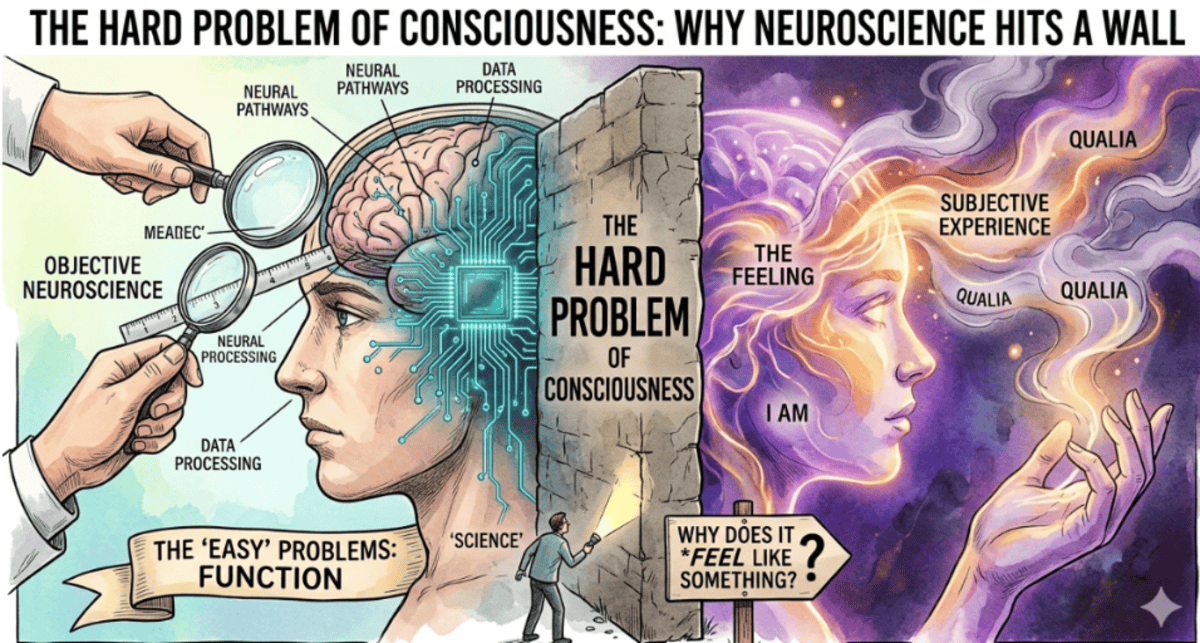
Our brain is one of the most complex working systems on Earth. Despite years of research, a lot still remains a mystery. One of such mysteries is “The Hard Problem of Consciousness ”, coined by philosopher David Chalmers, which distinguishes between the “easy” problems—like how the brain reacts to heat—and the “hard” one: why we actually experience the sensation of being burnt.
Here are four specific reasons why neuroscience, in its current form, hits a wall when trying to solve this mystery.
1. The Gap Between Function and Feeling
Neuroscience is basically the study of how our brain works. It explains how the brain integrates information, categorizes stimuli, and controls behavior. These are “mechanical” questions. Think of the brain like a computer. Neuroscience is good at explaining how all the parts connect and how the programs run.
However, there is a massive explanatory gap between a physical process (neurons firing) and a subjective feeling (the “redness” of a sunset). You can describe the physics of light and the biology of the retina perfectly, but none of those facts explain why you have an internal “movie” playing in your head.
2. The Mystery of Qualia
In philosophy, the internal, subjective components of our senses are called qualia. Examples include the bitterness of coffee, the sting of a cold wind, or the specific “vibe” of a melancholy song.
Neuroscience can track the “nociceptors” that fire when you stub your toe, but the “ouch” itself—the raw, painful quality of the experience—is invisible to medical instruments. We can observe the physical cause and the physical effect, but the middle step—the experience—remains scientifically “dark.”
3. The Limits of “Third-Person” Science
The scientific method is built on objectivity. For a fact to be “scientific,” it generally needs to be observable by anyone with the right equipment. This is “third-person” data.
Consciousness, however, is the ultimate “first-person” phenomenon. It is inherently private. You can see a scan of my brain while I’m in love, but you cannot observe my experience of love. Because science is designed to look at things from the outside, it struggles with a phenomenon that only exists on the inside. We are trying to use a ruler to measure the weight of a dream; we might simply be using the wrong tools.
4. The “Zombie” Argument
A famous thought experiment in this field involves “philosophical zombies.” Imagine a creature that looks and acts exactly like a human. It can hold a conversation, scream when hit, and solve math problems. However, it has no internal life—there is “nobody home.”
From a purely neuroscientific perspective, there is no reason why we aren’t all zombies. The brain’s functions could, theoretically, happen without any conscious awareness at all. The fact that we are aware suggests that consciousness isn’t just a byproduct of biology, but something much more elusive.
Conclusion
Neuroscience has given us a brilliant map of the brain’s “hardware,” but it has yet to find the source of the “light” that turns that hardware on. The Hard Problem suggests that consciousness might not be something the brain does, but rather something more fundamental that we don’t yet have the language to describe. Until we bridge the gap between objective matter and subjective mind, the wall will remain.
Frequently Asked Questions
What is the Hard Problem of consciousness?
The Hard Problem of consciousness refers to the difficulty of explaining why physical processes in the brain create subjective experiences, such as pain, emotions, colors, tastes, and feelings.
Why can’t neuroscience solve the Hard Problem?
Neuroscience can explain how neurons process information and control behavior, but it cannot fully explain why these physical processes produce conscious experiences. This gap between brain activity and personal experience makes the Hard Problem difficult to solve.
How is the Hard Problem different from the easy problems of consciousness?
The easy problems focus on explaining brain functions such as learning, memory, perception, and responses to stimuli. The Hard Problem, however, asks why these brain processes are accompanied by an inner, subjective experience.
Statutory Citations & References
[1] A. Harris, “The hard problem of consciousness, in 53 minutes,” Big Think, Feb. 02, 2026.(accessed May 10, 2026).
[2]“What Makes the World: Mind or Brain?,” Psychology Today, 2025. https://www.psychologytoday.com/us/blog/mind-matter-reality/202503/what-makes-the-world-mind-or-brain (accessed May 10, 2026).
[3]“What is neuroscience and why is it important?,” Patsnap.com, 2025. https://synapse.patsnap.com/article/what-is-neuroscience-and-why-is-it-important
Simplify your Business
Eve Consultancy is your trusted partner for end-to-end compliance services, including Company Incorporation, GST Registration, Income Tax Filing, MSME Registration, and more. With a quick and hassle-free process, expert guidance, and affordable pricing, we help businesses stay compliant while they focus on growth. Backed by experienced professionals, we ensure smooth handling of all your legal and financial requirements. WhatsApp us today at +91 9711469884 to get started.
Maximize Your Business Potential
Looking for a partner to advise on GST, ITR, Business Registration, or Financial Strategy? Our experts ensure your compliance is seamless and your solutions are optimized.
Book a Strategy ConsultationEve Finance: Your Daily Financial Eve-olution!
Finance made simple, fast, and fun! 🏦💡 Sign up for your daily dose of financial insights delivered in plain English. In just 5 minutes, you’ll be smarter and better!