
Liquidity Squeeze: How RBI’s Rupee Clampdown Is Tightening Credit for Indian Businesses
Published: Aug 10, 2026
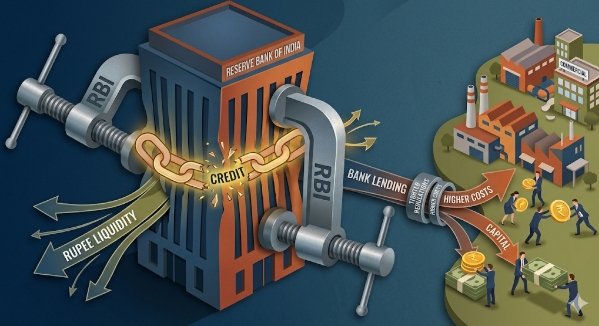
Key Regulatory Highlights
- RBI’s liquidity tightening has made borrowing more expensive for businesses.
- Banks are lending more cautiously, especially to MSMEs and smaller firms.
- NBFCs face higher funding costs, reducing credit availability in the market.
- Companies are focusing on cash flow, debt reduction, and alternative financing.
- The liquidity squeeze aims to control inflation and stabilize the rupee while strengthening long-term financial discipline.
1.The Starting of the Settling Cycle
The current state of the Indian cash grandstand is not a coincidental wonder but a calibrated move by the central bank. Over the past few quarters, the RBI has transitioned from an “unbiased” to a “withdrawal of comfort” position. The basic objective has been to tame settled inflationary weights and stabilize the rupee against an unsteady US dollar.
By utilizing rebellious tools such as the Variable Turnaround Repo Rate (VRRR) and keeping up a tall repo rate, the RBI has effectively sucked out the plenitude “slosh” that characterized the post-pandemic recovery period. For Indian businesses, this suggests the abundance of cash that banks once lent to credit has vanished, supplanted by a competitive scramble for stores. When the central bank fixes the tap, the first casualty is frequently the ease with which mid-market firms can secure short-term working capital.
2. The Influence on Bank Advancing and Credit Costs
As system-wide liquidity remains in deficiency, the component of bank crediting has experienced a basic alteration. Banks are no longer able to depend on cheap overnight savings to fuel their credit portfolios. In step, they are compelled to raise store rates to draw in retail save stores, which naturally pushes up their Brought of Saves (CoF).
This increase is unavoidably passed on to the final borrower. Indian businesses are directly standing up to higher, insignificant taken-a-toll-of-funds-based advancing rates (MCLR). For capital-intensive divisions like systems, honest-to-goodness inheritance, and creating, in fact, a 25-basis point climb can disentangle into millions of rupees in additional interest outgo. Other than that, banks have gotten to be continuously specific, prioritizing “AA” and “AAA” assessed corporates while settling the credit entryways for MSMEs (little scale, small, and medium endeavors), who are frequently the most defenseless to shifts in credit availability.
3. The MSME Issue: Surviving the Squeeze
While sweeping combinations can pivot to Exterior Commercial Borrowings (ECBs) or issue commercial paper to present-day money-related pros, MSMEs remain highly subordinate to the private sector overseeing an account channel. The current liquidity crunch hits this parcel the hardest.
With banks turning cautious, the “credit chance premium” for more diminutive players has spiked. Various small commerce proprietors report that though credit lines are really “open,” the collateral necessities and vows have finished up basically more inflexible. This makes an assistant’s well effect: conceded installments. When a small commerce cannot get to a bridge progress to cover a passing cash flow cleft, it delays installments to its claim suppliers, making a systemic quiet in the speed of cash over the supply chain.
4. Shadow: Overseeing an account and the NBFC Swell Effect
Non-Banking Financial Companies (NBFCs) play a critical role in coming to the “last mile” of Indian credit. Be that as it may, NBFCs themselves are major borrowers from the keeping-cash system. As the RBI fixes the rupee supply, banks prioritize their having arranged crediting over financing shadow banks.
The “swarming out” effect in the commitment publicizes that NBFCs are finding it more expensive to raise funds through non-convertible debentures (NCDs). In this way, the credit they deliver to vehicle buyers, gold credit searchers, and common commerce visionaries has finished up more exorbitantly. This settling of credit by means of the NBFC course acts as a double whammy for the Indian economy, as it moderates down utilization in semi-urban and rural zones, which are the customary engines of volume improvement for India’s FMCG and car sectors.
5. Key Recommendations for Indian Corporates
In this environment of an upheld liquidity crunch, the mantra for Indian CFOs has moved from “advancement at any cost” to “liquidity preservation.” We are seeing a checked float in
Deleveraging: Companies are prioritizing the repayment of high-cost commitments to secure their margins.
Alternative Financing: A surge in captivation toward private credit stores and esteem-debilitating limited to customary debt.
Working Capital Optimization: Businesses are settling their stock cycles and being more commanding with receivables collection to diminish reliance on exterior bank credit.
The RBI’s position is an overhaul where the return of capital is returning to unquestionable benchmarks. Though the clampdown is fundamental to expecting the economy from overheating and to guarantee the rupee’s getting control, the move is illustrating to be a trial by fire for the corporate sector’s budgetary resilience.
Conclusion
The period of “straightforward cash” has immovably pulled back into the rearview mirror. The persistent liquidity crunch is an assistance change that demands higher viability and way, way better budgetary education from Indian endeavors. As bank crediting gets to be more expensive and specific, businesses must look inward to optimize operations and outward to separate their subsidizing sources. While the RBI may unavoidably ease its grip as development targets are met, the lessons learned in the midst of this period of settling will likely characterize the cash-related strategies of Indian businesses for a long time to come. In brief, investigating the liquidity crunch is no longer reasonably a treasury challenge—it is a center exchange imperative.
Frequently Asked Questions
What is a liquidity squeeze?
A liquidity squeeze occurs when there is less money available in the banking system, making loans harder and more expensive to obtain.
What is a liquidity squeeze?
A liquidity squeeze occurs when there is less money available in the banking system, making loans harder and more expensive to obtain.
How does higher liquidity tightening affect businesses?
Businesses face higher borrowing costs, stricter lending conditions, and reduced access to working capital.
Why are bank loans becoming more expensive?
Banks are paying higher interest rates to attract deposits, increasing their funding costs, which are passed on to borrowers.
Why are MSMEs more affected than large companies?
MSMEs rely heavily on bank loans and often have fewer financing alternatives than large corporations.
How are NBFCs impacted by the liquidity crunch?
NBFCs face higher borrowing costs from banks and financial markets, making their loans more expensive.
What is the impact on supply chains?
Limited access to credit can delay payments between businesses, slowing the movement of money across supply chains.
How can companies manage during a liquidity crunch?
They can reduce debt, improve cash flow management, optimize working capital, and explore alternative financing options.
Does RBI’s liquidity tightening have any benefits?
Yes. It helps control inflation, supports the rupee, and reduces the risk of economic overheating.
Will the liquidity squeeze continue indefinitely?
Not necessarily. The RBI may ease liquidity conditions once inflation is under control and economic conditions improve.
Statutory Citations & References
[1] Spare Bank of India, “State of the Economy,” RBI Bulletin, vol. LXXVII, no. 12, pp. 15-42, Dec. 2023.
[2] N. Subramanian and S. Gupta, “Budgetary Approach Transmission and the Indian Corporate Division,” Journal of Budgetary Courses of Action, vol. 15, no. 3, pp. 210-228, 2024.
[3] Credit Rating Information Organizations of India Compelled (CRISIL), “Influence of Liquidity Deficiency on MSME Credit Stream,” Annual Sectoral Report, Mumbai, India, 2024.
[4] J. Patel, “The Progression of Shadow Keeping Cash in India Post-Tightening,” Indian Monetary Study, vol. 59, no. 1, pp. 45-67, 2023.
Maximize Your Business Potential
Looking for a partner to advise on GST, ITR, Business Registration, or Financial Strategy? Our experts ensure your compliance is seamless and your solutions are optimized.
Book a Strategy ConsultationEve Finance: Your Daily Financial Eve-olution!
Finance made simple, fast, and fun! 🏦💡 Sign up for your daily dose of financial insights delivered in plain English. In just 5 minutes, you’ll be smarter and better!