
7 Breakthrough Ways in Which CRISPR is Changing Precision Medicine
Published: Jun 16, 2026
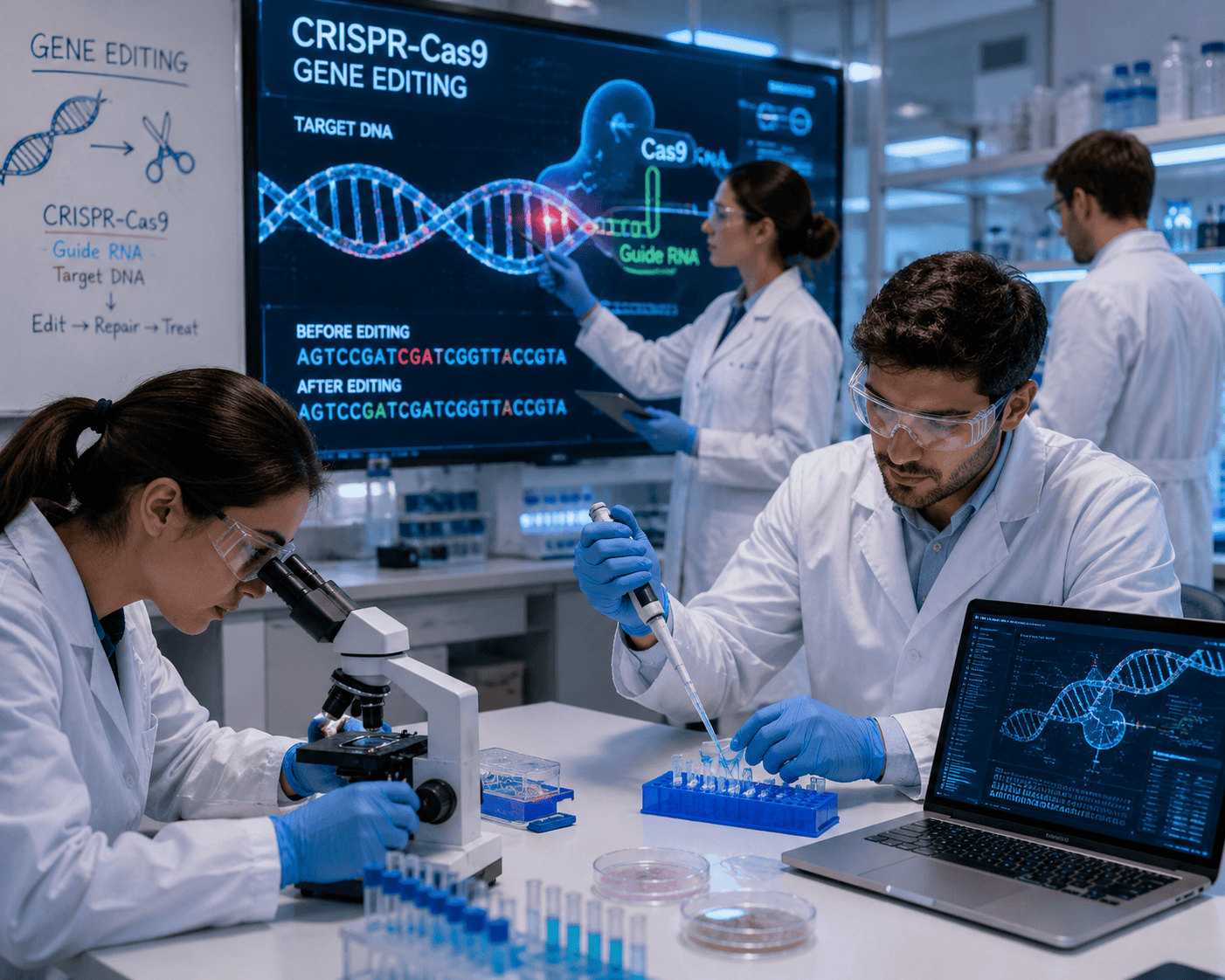
CRISPR technology of genetic editing has become one of the newest and most promising developments in the field of biotechnology. Many specialists try to find applications of this technology in curing and diagnosing different diseases. CRISPR technology enables scientists to treat various diseases and discover novel approaches to treating them.
Nowadays, the healthcare sector is progressively moving towards more personalized treatment options, which are known as ‘precision medicine’. Rather than administering the same drugs to all patients, precision medicine aims to analyze and utilize each patient’s genetic predisposition to achieve better results. With the introduction of this approach to healthcare, medicine will change in terms of precision, data analysis, and an individual patient-centric approach. This biotechnology enables researchers to modify genes and their defective sequences to eliminate hereditary problems at their source. Despite being relatively young, CRISPR technologies significantly changed the direction of the development of medicine. As the technology advances further, CRISPR can evolve into one of the strongest driving forces of healthcare innovation.
1- Understanding CRISPR Technology
CRISPR is an acronym for “Clustered Regularly Interspaced Short Palindromic Repeats”. It is an editing technique that uses the immune system of bacteria to protect itself from viruses. The technology was later used by scientists to edit genes of plants, animals, and humans very precisely. It cuts the DNA of a living organism and makes it possible to insert new information into its genome. In comparison to earlier DNA modification techniques, CRISPR is relatively quick and inexpensive.
2- Treatments for Genetic Disorders
The application of CRISPR in precision medicine that has seen significant progress involves treating various genetic disorders. Sickle cell anemia, cystic fibrosis, muscular dystrophy, and other such conditions are the result of mutations of DNA sequences. Through the application of CRISPR technology, one can locate specific defective genes and treat them. Rather than just treating symptoms and dealing with the issue temporarily, such methods have the potential to offer long-term relief to patients. Currently, clinical trials using CRISPR technology are underway to explore such possibilities.
3- Progress in Cancer Research
The field of cancer treatment is also witnessing positive developments thanks to CRISPR. The process of gene editing can be used by researchers to analyze cancer cells and to design therapies that are more effective in treating this disease. With the help of CRISPR, researchers can make changes to immune cells that would allow them to identify cancer cells and fight them more efficiently. This technique is associated with immunotherapy and may offer advantages in terms of higher efficacy while minimizing harm to healthy cells.
4- Personalized Medicine and Treatment of Diseases
Most of the standard treatment procedures yield varied outcomes in different individuals since all human beings have distinct genomes. The concept of precision medicine tries to address this problem by designing treatment processes depending on an individual’s genetic information. Gene editing through CRISPR facilitates the application of personalized medicine in that scientists can determine variations in the genome that cause certain diseases and reactions to various medications. In the future, gene editing will help doctors devise personalized treatment processes for their patients.
5- Enhancing Medication Development
The development of new drugs is typically costly and laborious. Scientists in the pharmaceutical industry have discovered ways to accelerate the drug development process with the help of CRISPR technology by improving genetic studies and disease simulation. Scientists can use CRISPR to create manipulated cells and models for experiments that mimic diseases affecting humans. This allows for more efficient testing of new medications before human trials.
6- Ethical Issues and Safety Issues
CRISPR has various advantages, but it also poses many ethical and safety issues. Gene editing, especially concerning human embryos, is a controversial topic in many parts of the world due to many questions that have been raised by the use of the gene-editing technique in practice. Concerns are raised with regards to unintended modifications, risks, misuse, and future health problems associated with genetic manipulation. Some professionals believe there is a possibility of developing “designer babies” and genetically engineered people.
7- The Future of CRISPR in Medicine
The future of CRISPR in medicine appears to be very promising indeed. Studies will be done on the applications of CRISPR in the treatment of infections, brain disorders and geriatric diseases. In addition, new forms of CRISPR technology can be developed to enable the editing of genes with greater efficiency and fewer dangers involved. CRISPR may eventually be adopted by all healthcare systems as a routine medical procedure.
Conclusion
The future of precision medicine has been transformed dramatically owing to the introduction of new and promising technology such as CRISPR. With this, genetic disorders can be cured, and there is hope that even cancer can be treated successfully using this technology. The ability of this technology to edit genes makes it very important and valuable for scientists and doctors all over the world. The application of CRISPR in modern medicine is considered an important breakthrough that will help in the evolution of healthcare practices. From better drug creation to gene-based treatments, CRISPR will bring many changes to disease management and treatment. Though this technology faces some ethical concerns, its proper regulation and research can overcome those challenges.
Frequently Asked Questions
What is gene editing in medicine?
Gene editing is a scientific technique that allows researchers to modify DNA sequences within living cells. It can help correct genetic mutations and support the development of targeted treatments for various diseases.
How can gene editing help treat genetic disorders?
Gene editing can identify and repair faulty genes responsible for inherited conditions. This approach may provide long-term treatment solutions by addressing the root cause of a disease rather than only managing symptoms.
How does precision medicine benefit patients?
Precision medicine uses a patient’s genetic information to create personalized treatment plans. This can improve treatment effectiveness, reduce side effects, and help doctors choose the most suitable therapies.
Statutory Citations & References
[1] J. A. Doudna and E. Charpentier, “The New Frontier of Genome Engineering with CRISPR-Cas9,” Science, vol. 346, no. 6213, pp. 1258096, 2014.
[2] F. Zhang et al., “Genome Editing with CRISPR-Cas Systems,” Cell, vol. 157, no. 6, pp. 1262–1278, 2014.
[3] E. S. Lander, “The Heroes of CRISPR,” Cell, vol. 164, no. 1–2, pp. 18–28, 2016.
Simplify your Business
Eve Consultancy is your trusted partner for end-to-end compliance services, including Company Incorporation, GST Registration, Income Tax Filing, MSME Registration, and more. With a quick and hassle-free process, expert guidance, and affordable pricing, we help businesses stay compliant while they focus on growth. Backed by experienced professionals, we ensure smooth handling of all your legal and financial requirements. WhatsApp us today at +91 9711469884 to get started.
Maximize Your Business Potential
Looking for a partner to advise on GST, ITR, Business Registration, or Financial Strategy? Our experts ensure your compliance is seamless and your solutions are optimized.
Book a Strategy ConsultationEve Finance: Your Daily Financial Eve-olution!
Finance made simple, fast, and fun! 🏦💡 Sign up for your daily dose of financial insights delivered in plain English. In just 5 minutes, you’ll be smarter and better!