
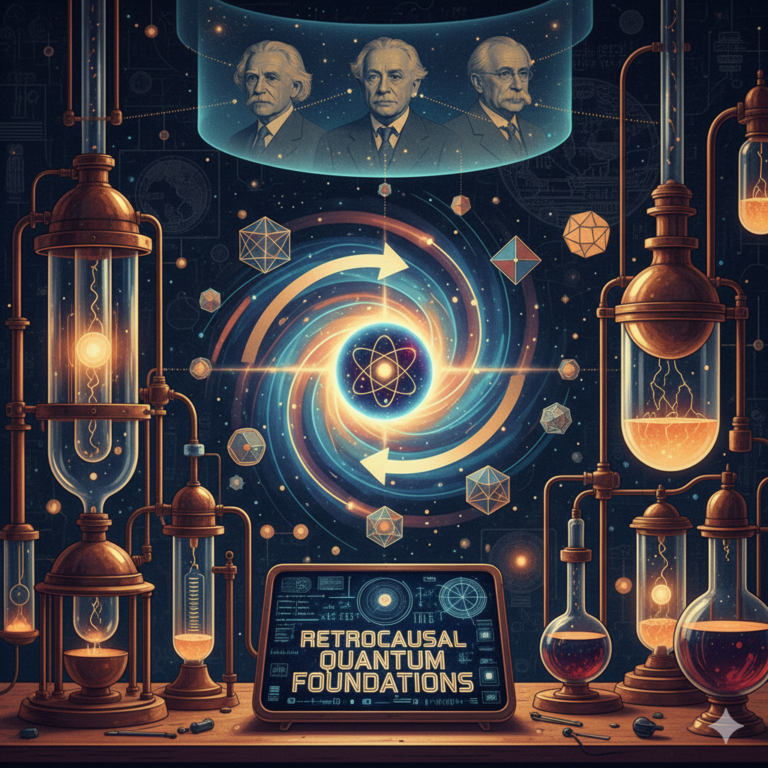
Retrocausality and the Price Wharton model address questions philosophers have asked since ancient times.
Do We Have Control Over Our Actions? OR Are Our Actions Predetermined by Prior Events?
Answers to these questions can be found in different literary sources ranging from Buddhist texts – to – Aristotle’s book, politics – to Chinese philosopher Confucius’s teachings. All these texts and ideas are centered around the concept of time and causality. This concept received further enhancement when it became a subject of study in the field of Physics. By studying it multidimensionally through the lens of physics and philosophy a new school of thought emerged which is now popularly known as – Retro-causality also known as retrocausation.
Retrocausality is a concept of physics that suggests the possibility of causal influences travelling backward in time. This idea challenges the traditional notion of causality which promotes that causes precedes effects. To simplify it in simple words, let’s take an example – if we analyze natural calamities such as floods, cyclones, landslides or mudflows, etc., the causes of the same are not only natural, but are more anthropological.
In India, since the past decade, the Himalayan states regularly faced the issue of landslides or mudflow resulting in huge loss of life and property. After studying in depth regarding the causes of the same it was highlighted that irregular and unscientific methods of construction led to increased natural calamities affecting the demography deeply. Thus this concept suggests that a particular event can be encoded and transmitted back in time through the process of quantum teleportation giving more importance to causes and to effects.
Taking into consideration the above example it can be understood that the study through retrocausality can make us understand, interpret and analyze a particular situation or event from the perspective of causes resulting in such events and then focusing on effects. This will allow policymakers, administrators, industrialists, entrepreneurs, etc. to understand a particular phenomena through analytical rigor and critical reasoning allowing them to bridge the gap between the cause and effect spectrum. Thus it can be said that the implications of Retrocausality can have far reaching and significant consequences of our understanding regarding a situation through time and space.
In order to understand how Retrocausality works, it is important to understand the different models through which it executed –
1. All-at-once Lagrangian Model –
This model was used by Ken Wharton who proposed using action principles that utilise initial and final boundary conditions. In this method, past incidents/field study are treated as outputs of global calculation rather than inputs paving way for future measurements to influence them.
2. Transactional Interpretation –
This method acts as a handshake forwards moving offer and backward moving confirmation which meets to form a transaction or a real physical event.
3. Casually Symmetric Bohm Model –
An extension of Bohemian mechanics – this model supplements the usual forward evolving quantum state with a backward evolving state, fixed by a future boundary condition.
4. Two State Vector Formalism –
A complete quantum description contains a state vector that moves forward and a state vector that moves backward in time from the future boundary conditions towards the past. It is only a combination of complete measurements at both final and initial boundaries that can provide a complete specification of a quantum system.
5. Toy Model –
illustrates how retrocausality could be possibly realized. This highlights causal bi-directionality, i.e., both ordinarily move forward causality and retrocausality, understood in an interventionist sense.
6. The Relational Block world Interpretation –
The ontology of this interpretation consists of so – called “spacetime source elements”, which are characterized as “amalgams of space, time and sources”.
These models can be useful in the application in the following manner –
1. Quantum Computing –
Would lead to enhancement of computational efficiency, improve error correction and offer reliable methods for data storage and retrieval in quantum computers.
2. Artificial Intelligence –
Can help in developing better decision-making processes, potentially enhancing predictive modelling and strategic planning in complex scenarios.
3. Policymaking and Governance –
Can significantly help governments to analyze current data on policies and schemes, and provide impact driven implications in bridging the gap between aspirations of the citizens and formed policies by covering up the gaps of the former.
4. Agricultural, Industrial and Banking Sectors –
Can be useful in the primary, secondary and tertiary sectors of the economy to understand, analyze, and critically realize the current, present and the future courses of action needed to evolve and develop reliable methods to get improved results formed through better understanding of causes and then effects of various phenomena.
Conclusion
Thus, from the above information it can be interpreted that RETROCAUSALITY IN QUANTUM MECHANICS and its MODELS can help us significantly to improve predictive accuracy by accounting for feedback loops and complex interactions between variables. This will allow individuals to develop better understanding of past-present-future phenomena based on providing importance to causes and then effects.
References
[1] “Recasuality In Quantum Mechanics,” Stanford Encyclopedia Of Philosophy Archive, Nov 13, 2023. [Online].
Available: https://share.google/aLpkaONXUXU6JuTta
[2] “What is Retro-Causality?”, Quantum Zeitgeist. [Online].
Available: https://share.google/VqAr8cqteDt3oMghq
[3] “A New Class of Retrocausal Models,” National Library of Medicine.[Online].
Available: https://share.google/Xf3Y9FGabUaI9zu5h
[4] “Physics provides support for retrocausal quantum theory, in which the future influences the past,” Physorg.[Online].
Available: https://share.google/78VL7WQWBVzXiD9qk
FAQs
1. What is the core concept of retrocausality in finance?
It suggests that future outcomes can provide significant data points to better understand current business value.
2. How does the Price Wharton framework assist consultants?
This model provides a structured approach to analyzing complex variables that traditional valuation methods might miss.
3. Is this approach suitable for all business types?
It is most effective for high-growth firms or industries where future market shifts heavily dictate current worth.
4. Why is this model gaining traction now?
As markets become more volatile, firms need more sophisticated tools to account for non-linear growth and future events.
Penned by Krushna
Edited by Pranjali, Research Analyst
For any feedback mail us at info@eveconsultancy.in
Finance made simple, fast, and fun! 🏦💡 Sign up for your daily dose of financial insights delivered in plain English. In just 5 minutes, you’ll be smarter already!
Simplify Your Business Compliance with Eve Consultancy
Eve Consultancy is your trusted partner for end-to-end compliance services, including Company Incorporation, GST Registration, Income Tax Filing, MSME Registration, and more. With a quick and hassle-free process, expert guidance, and affordable pricing, we help businesses stay compliant while they focus on growth. Backed by experienced professionals, we ensure smooth handling of all your legal and financial requirements. WhatsApp us today at +91 9711469884 to get started.