
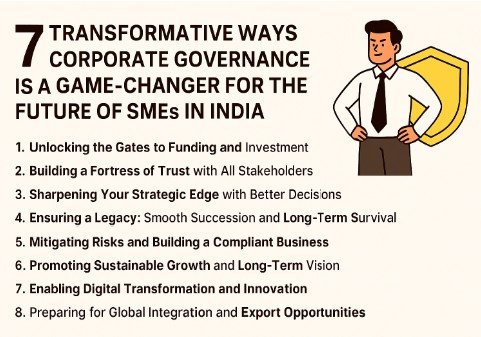
For businesses today, corporate governance has become one of the critical pillars of the sustainable development of Entrepreneurial Start-ups and Small and Medium Enterprises (SMEs) in India. About 6.3 crore SMEs, representing a nearly 30% contribution to the GDP and employing over 110 million people, are the support backbone of the Indian economy alongside the side steel sector. However, SMEs continue to face issues with transparency, accountability, and compliance. A good governance system can dramatically improve these challenges.
The importance of corporate governance in SMEs is no longer a choice; it is a necessity. As India integrates into the global supply chain and foreign investment recognizes India as a viable opportunity, SMEs need to transform from informal business to formal business. Good corporate governance principles can ensure not only compliance but trust, efficiency, and sustainability in business operations.
For the average SME owner in India who is busy trying to keep the doors open, making sales, and tracking finances, it can be perceived as a distant, over-formalized, or ill-formalized concept that is only relevant for large companies.
However, a robust corporate governance system is no longer optional for an SME; it is the basis on which sustainable growth, trust, and long-term success rest. It is the secret sauce that can change a small family organization into an institution that survives generations.
1. Unlocking the Gates to Funding and Investment
Accessible capital continues to be one of the top challenges that small and medium-sized enterprises (SMEs) face in India. While these businesses have immense potential, many find it difficult to secure capital due to limited financial disclosures and unstructured practices of management that cause them to be seen as risky in the eyes of banks and lenders.
This perception gap becomes an impediment to the growth and scale of these enterprises. The Reserve Bank of India has reported that SMEs with a formal governance framework are 30% more likely to receive loans or investment than those without. Overall, a firm’s transparency and accountability in its financial dealings are the key factors in its chance to get credit.
Today’s investors are increasingly placing value on businesses that conduct themselves ethically, remain in compliance with the law, and have unambiguous ownership structures. SMEs that are transparent in their financial records, have a sensible hierarchy of decision making, and document sound governance practices are viewed as safer and more reliable.
The presence of audited statements, minutes of meetings of boards (however advisory), and policies for internal transactions all suggest to potential funders that the enterprise has a responsible steward for capital. These various governance mechanisms (auditing, board oversight, and transparency) not only build credibility but also reduce risk.
As India’s financial ecosystem continues to mature, SMEs that are committed to adherence to governance best practices will be better positioned to obtain venture capital, private equity, and foreign investors. While SMEs may seem riskier to investors simply due to their size, the right governance can safeguard them.
2. Building a Fortress of Trust with All Stakeholders
Corporate governance is essential for the future of SMEs in India, not just to attract investors but to build trust across their entire ecosystem, employees, customers, suppliers, and the local community.
By embedding good governance principles into the day-to-day operation, you foster an enforceable level of accountability and transparency, while also setting a standard for a performance-oriented culture.
Employees have the advantage of receiving fair HR practices, reliable communication provisions, integrity in performance evaluation, and increased morale, resulting in decreased turnover. SMEs that adopt internal controls, for example, a system of delegated authority or regular oversight of financials, typically experience enhanced operational efficiency.
Synergistically, “structured governance” helps separate personal decisions from management, so SMEs can balance the need for entrepreneurial agility and operational discipline. The visibility generated from governance structures assists in decision-making and prepares SMEs for effective competition in rapidly movement environments.
For customers and suppliers, governance essentially means SMEs can be counted on to pay on time, honour contracts, and provide quality products. Good governance is creating a reputation that cannot be bought and transforms customers into advocates for the brand and suppliers into partners.
Simply put, at the end of the day, trust is the most beneficial currency that SMEs can have. This is especially true of companies that base much of their operations on social networks and community goodwill. Practicing corporate governance principles instils some level of credibility with all stakeholders and establishes a culture of fairness and integrity. It is not just about being compliant with rules and regulations; it is about sustaining a loyalty-based brand, reputation, and long-term relationships.
3. Sharpening Your Strategic Edge with Better Decisions
In India, many small and medium-sized enterprises (SMEs), particularly family-owned businesses, face a similar challenge: their decision-making is largely centralized, emotional, and lacks diversity. While the founder’s vision is important, it can become a bottleneck and give way to echo chambers and mistakes that could cost the business significant amounts of money.
A relatively straightforward concept of governance for your business, such as an advisory board, could be a game-changer. An advisory board consists of informally assembled mentors or field experts from whom you can seek advice.
Some members might include an experienced finance professional, a marketing specialist, an advocate, or a thought leader in your industry. Their role is to help you by looking at things objectively and thinking out of the box, while also keeping the importance of rational and mindful businesses on your radar.
Establishing this structure leads you to look at your business issues in different ways. It builds in time for debate and thoughtfulness as you make significant decisions about business growth, how and when to introduce new products, and major investments.
This structure serves to compartmentalize ownership from management and run your business more professionally, moving the conversation away from “what I feel is right” to also include “what is the data showing us, and what does our collective experience tell us is right,” which is critical in today’s complex marketplace.
4. Ensuring a Legacy: Smooth Succession and Long-Term Survival
A story of deep sadness in the Indian business space is the tale of a successful first-generation business slipping away following the founder’s departure from the business. This often occurs due to the absence of a formal succession plan.
When there is no formalized governance structure governing the transition of leadership, the result is bad news for the business. Family disputes can erupt, individual egos can rise, and ultimately, these employment misunderstandings can lead to the demise of the business. Corporate governance is important here.
While sometimes overlooked, a well-developed governance plan establishes a clear path for what lies ahead. Neglecting to plan for the next chapters of your business can lead to confusion, family disputes, retaliation, etc.
Good governance can specify the responsibilities for the next generation, dimensions, metrics for leadership selection other than seniority, and represent the development of a reasonable process to navigate the transfer of ownership and control. If the governance process is documented and executed while the founder is fully apprised of the plans, you can take comfort, with a well-led transition, in knowing the plan worked.
This is the professional aspect that establishes a new norm, manages the fragile emotions of a family-run business, assures the plans cannot be scuttled, and ultimately demonstrates how to transform your business from a personal project to a family experience.
5. Mitigating Risks and Building a Compliant Business
In their efforts to expand their businesses, many small and medium-sized enterprises (SMEs) in India overlook compliance and risk management. Serious penalties, litigation, and reputational damage could easily arise from non-compliance with tax law, labour law, and environmental law.
As changes will be expected in legislative agendas and sufficiently covering such areas as the Companies Act of 2013, the MSME Development Act, 2006, and ESG legislation, regulatory compliance will incorporate an assurance of proper governance.
Corporate governance is a mechanism to manage compliance and risk management systematically. Corporate governance allows SMEs to develop internal systems needed for proper governance. Among these systems are accurate record-keeping, timely submission of taxes, compliance with labour laws, and meeting environmental regulations.
Corporate governance will become a control mechanism of checks and balances for the internal systems, especially for SMEs, whose internal system exists for managing ethics and legality. In the case of SMEs, developing systems will respond to fiscal controls and compliance with regulation/statute changes in a timely manner to mitigate internal/external risk.
Well-governed SMEs are better able to manage volatility. They may employ tools to manage risk, including risk registers, periodic reviews, and risk identification. They may also identify insurance, cyber risk, and a myriad of potential threats before they have an economic impact, such as economic uncertainty or any aspect of financial instability.
In the post-pandemic period, corporate governance has increasingly served as the foundation of business continuity. It also lets SMEs stay afloat against the business storm, improving their chances of avoiding a business collapse. Ultimately, corporate governance is a way to safeguard growth, reputation, and sustainability, and even resources.
6. Promoting Sustainable Growth and Long-Term Vision
While profitability is always a priority, sustainability is the one that allows businesses to continue to exist. Good corporate governance helps SMEs think in the long term and weigh profitability alongside environmental and social considerations.
As India’s emphasis on sustainability rises, governance structures can help SMEs with oversight align with Sustainable Development Goals (SDGs) and the Environment Policy. For example, the adoption of more efficient production values in meeting market needs, improving labour conditions, and establishing waste management systems can help us open more markets and new opportunities for partnership.
Governance can also be a way for boards of advisors with outside perspectives to help entrepreneurs develop a long-term horizon beyond daily firefighting. Therefore, governance can be viewed as a compass towards regulated growth for SMEs over the long term.
7. Enabling Digital Transformation and Innovation
Digitalization is transforming the entire business landscape, yet many small and medium-sized enterprises (SMEs) in India, particularly, continue to operate in a traditional manner due to not having structured planning or a digital vision. Corporate governance can have a powerful role in enabling digital transformation by providing clarity and accountability when adopting a technology.
A governance-led approach significantly enhances data management, cybersecurity procedures, and a planned budget for technology investment. In this instance, if a small logistics SME wanted to digitize their tracking and invoicing systems within a governance framework, this would provide better operational efficiencies, improved accuracy of data, and an enhanced customer experience.
Governance will also encourage a culture of developing digital skills for staff so they are more capable of working smarter and contributing to a culture of ongoing innovation. In a fast-paced, constantly changing business landscape, innovation and governance are not contradictory interests; they each complement one another.
SMEs with governance included in their digital plan will be more resilient, agile, and competitive. Enterprises will more effectively rebound from disruption, will meet customer expectations, and will be able to develop business sustainability and scaling opportunities.
At the end of the day, governance is more than being compliant – it is the catalyst to develop digital maturity whilst transitioning from reactive operations to proactive, tech-enabled growth. Governance principles should also be established and aligned within their digital activity, so SMEs can effectively engage in the new digital economy and enhance their opportunity of developing a future-ready organization.
8. Preparing for Global Integration and Export Opportunities
As Indian small and medium enterprises (SMEs) increasingly participate in global supply chains, they must comply with international norms of governance and ethics. Buyers, investors, and partners in other countries generally expect businesses to behave transparently, to be compliant with the law, and to be environmentally responsible.
As the India Brand Equity Foundation (IBEF) points out, Indian SMEs’ exports are growing regularly and contribute about 45% of total exports. But there is still one major barrier: their lack of governance equivalent to international norms. Establishing governance frameworks based on international standards, such as ISO standards, environmental reporting, and board independence, allows SMEs to access and compete in new markets.
In fact, many large multinational companies prefer to engage with SMEs that have well-established high standards of corporate governance, as it is safer from operational risk and reputational risk. Hence, governance allows SMEs to transition from being local businesses to global trusted partners.
Government and Institutional Support for Governance in SMEs
India’s efforts to establish a governance-led entrepreneurial ecosystem are supported through various strategic measures from different institutions. The Ministry of Corporate Affairs (MCA) has simplified compliance for small businesses making compliance easier and cheaper for SMEs. The Small Industries Development Bank of India (SIDBI) likewise invests in training to assist SME entrepreneurs to learn and apply good governance practices.
In addition, initiatives like the EMERGE initiative of the National Stock Exchange reward well-governed SMEs with lists and capital opportunities transparently and procedurally reinforcing ethical decision-making and a standard of governance with SMEs. Furthermore, government-sponsored incubators and start-up missions promote early-stage businesses embedding sustainability and governance in their models, instilling a culture of transparency and accountability into the DNA of early-stage SMEs.
Governance Starter Kit for SMEs
By starting small and staying consistent, SMEs can build a governance foundation that attracts funding, retains talent, and strengthens reputation without overwhelming complexity.
Challenges in Implementing Corporate Governance in SMEs
While the benefits are clear, implementing corporate governance in SMEs is not without challenges. Many small business owners view governance as a cost rather than an investment. Limited financial resources, lack of professional management, and inadequate awareness are major obstacles.
In smaller firms, ownership and management are often intertwined, making it difficult to establish independent oversight. Additionally, compliance procedures can be complex and time-consuming, deterring small firms from formal adoption.
However, government initiatives like the MSME Governance Toolkit, Digital MSME Scheme, and training programs by the Institute of Company Secretaries of India (ICSI) are gradually improving awareness.
SMEs that begin with basic governance practices such as regular audits, board meetings, and documented policies can evolve progressively without financial strain. The journey may be gradual, but its impact is transformative.
Governance as a Growth Engine
In the coming decades, the nexus between corporate governance and success will only grow stronger. As India aspires to become a $5 trillion economy, SMEs will have an important role in driving exports, innovation, and jobs.
However, with that growth comes heightened expectations of governance from global investors and partners. SMEs that embrace the opportunity of Environmental, Social, and Governance (ESG) reporting, gender diversity, and ethical leadership will reap the rewards not only in reputation but also with the financial implications of good governance.
In the coming years, with the expanded availability of digital compliance solutions and cloud-based governance solutions, it will become easier for SMEs to navigate and implement good governance solutions at a lower cost. In the next 10 years, governance will not be a realm of privilege for large corporations but will be the foundation for every responsible small business in India.
Conclusion:
For a forward-looking SME owner in India, the most strategic investment you can make for your company’s future is into corporate governance. Corporate governance is not about adding more bureaucracy; it is about creating a strong, stable, and scalable platform for your future. It will be the very infrastructure that will create conditions for investment, create trust, improve decision-making, protect your legacy, and protect against risk.
Corporate governance is the framework for creating a small business into a credible, scalable, and sustainable SME. It creates trust among investors, it provides safeguards against compliance, it fundamentally improves efficiency and opens the door to opportunities across the globe.
For SMEs in India’s vibrant economy, government governance is not only manageable, it is a pathway to growth. As India moves toward being a global economic powerhouse, those SMEs that adopt a governance model that incorporates transparency, accountability, and ethical leadership will shape the future of a new Indian entrepreneurship.
The transition from a small business to a trusted brand begins with a single, powerful move: good governance. By taking these principles seriously, you will be on a journey of transforming your small business into a respected business institution that can last for decades. You must start now.
References
[1] “Corporate Governance for SMEs,” The Institute of Company Secretaries of India (ICSI). [Online]. Available: https://www.icsi.edu/media/website/SMEBooklet.pdf
[2] “Strengthening SMEs in India: The Role of Corporate Governance,” International Finance Corporation (IFC), World Bank Group. [Online]. Available: https://www.ifc.org/wps/wcm/connect/corp_ext_content/ifc_external_corporate_site/home
[3] “SEBI (Listing Obligations and Disclosure Requirements) Regulations, 2015,” Securities and Exchange Board of India. [Online]. Available: https://www.sebi.gov.in/legal/regulations/sep-2015/securities-and-exchange-board-of-india-listing-obligations-and-disclosure-requirements-regulations-2015-last-amended-on-september-07-2021-_33445.html
[4] Reserve Bank of India, “Trends and Progress of SMEs in India,” 2024. [Online]. Available: https://rbi.org.in
[5] Ministry of Corporate Affairs, “Corporate Governance and MSME Framework,” Government of India, 2023. [Online]. Available: https://mca.gov.in
[6] NITI Aayog, “SME Financing and Governance in India,” 2024. [Online]. Available: https://niti.gov.in
[7] India Brand Equity Foundation, “MSME Export Outlook,” 2024. [Online]. Available: https://ibef.org
[8] SIDBI, “Small Industries Development Report,” 2023. [Online]. Available: https://sidbi.in
[9] Deloitte India, “Corporate Governance Trends in Indian Enterprises,” 2024. [Online]. Available: https://www.deloitte.com
[10] Institute of Company Secretaries of India, “Governance Toolkit for MSMEs,” 2023. [Online]. Available: https://www.icsi.edu
 FAQ Section: Corporate Governance & Future of SMEs in India
-
What is corporate governance in the context of Indian SMEs?
Corporate governance refers to the systems and processes that ensure accountability, transparency, and ethical conduct in ensuring the future of SMEs in India. -
Why is corporate governance important for the future of SMEs in India?
Strong corporate governance builds trust, attracts investment, and supports sustainable growth—key to shaping the future of SMEs in India. -
How does poor corporate governance affect future of SMEs in India?
Weak corporate governance can lead to financial mismanagement, loss of stakeholder confidence, and hinder the future of SMEs in India. -
Can corporate governance help SMEs access funding?
Yes, investors and lenders prefer businesses with sound corporate governance, which directly impacts the future of SMEs in India. -
What are the key pillars of corporate governance for SMEs?
Transparency, accountability, board oversight, and stakeholder engagement are vital for the future of SMEs in India. -
Is corporate governance mandatory for all SMEs in India?
While not legally required for all, adopting corporate governance practices is increasingly essential for the future of SMEs in India. -
How can digital tools support corporate governance in SMEs?
Tech platforms streamline compliance, reporting, and decision-making—enhancing corporate governance and the future of SMEs in India. -
What role do boards play in SME corporate governance?
Boards provide strategic direction and oversight, reinforcing corporate governance and securing the future of SMEs in India. -
Are there government initiatives promoting corporate governance in SMEs?
Yes, schemes like MSME Champions and Udyam Registration encourage better governance, supporting the future of SMEs in India. -
How can SMEs start implementing corporate governance frameworks?
Begin with clear policies, financial transparency, and stakeholder communication to strengthen corporate governance and shape the future of SMEs in India.