
Topics: valuation methods, business evaluation
Every entrepreneur requires, at some point, to comprehend the life cycle of their enterprise. A robust business appraisal is especially important if one is planning to sell, attract investors, or take a business loan. It is more than numbers, as much as it is about understanding the real story behind those figures regarding your business’s health, potential, and risks. So, how do you find out the ‘worth’ of your business? Let’s analyze the most common business valuation methods step by step.
A business valuation is almost like appraising a house. Unlike determining the price of a house using its purchase value, a house has a myriad of attributes to consider including its current state, location, recently sold comparable homes and potential for further appreciation. Business valuation works on the same principles but has different neighborhoods and features to consider.

Understanding the Basics: What is Business Valuation?
Business valuation is the assessing, determining, estimating, and valuing process of all tangible and intangible assets of a firm or company unit. It can be used to resolve disputes, determine buy and sell clauses, quantify estates for tax purposes, corporate restructuring, establishing investment value, convening an appraisal through a partner entry, markup, and even dissolving partnerships. Ultimately, it assist firms determine potential stakeholders in turning around their business, paying for it as a reasonable rate.
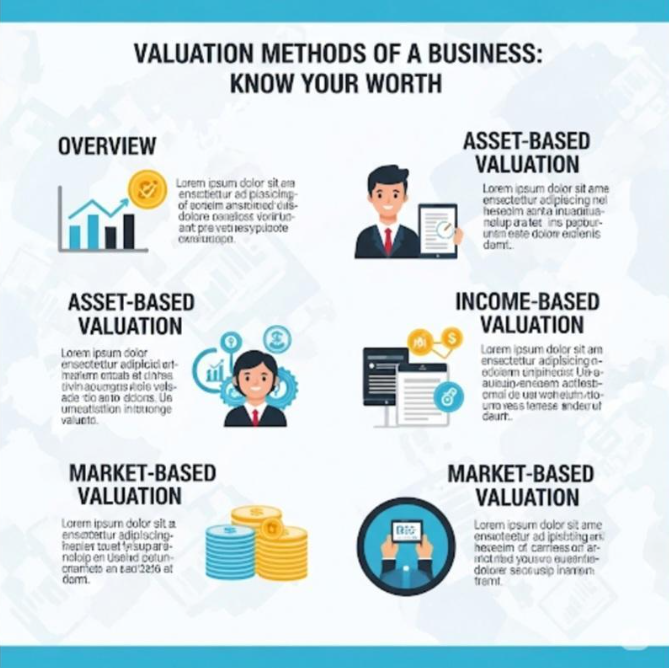
There are several bussiness valuation techniques to valuing a business that are generally accepted as appropriate, each with its own merits and best use cases.
1. Asset-Based Valuation.
This is typically the easiest and most widely used approach. What happens is you simply take all of your company’s tangible and intangible assets, add them together, and then subtract your liabilities. Think about it like selling a car. You would get the current market value, add the upgrades, and subtract any outstanding debt on it. For a company, this usually includes everything from cash, accounts receivable, inventory, machines, real estate, and, less commonly but still often valuable considerations, patents or trademarks and brand equity. While this may seem like the easiest way to value a business, there are times this method will understate the businesses value, especially businesses with a high reliance on intellectual property or in the case of service companies where the value is placed more on human capital to generate value for the clients versus physical assets.
2. Valuation Based on the Market.
This method is simply about comparisons. It examines the recent sales of similar businesses in your industry. For example, if you are selling a coffee shop, you would look for the sale prices of similar businesses (in terms of size, location, and profitability) that have sold. This method is typically the most effective when there are an adequate number of similar comparable businesses for the transactions that you are evaluating. Unfortunately, true comparables are rare since no two businesses are identical. Each will have a different personality, different customer bases, and different efficiencies, which makes it difficult to make direct comparisons. It’s like trying to find a copy of your house – right down to the paint chips good luck!
3. Income-Based Valuation.
One of the most advanced and adaptable methods, in particular for business’ with prior earnings and profitability records, is an approach called Income-Based Valuation. The method focuses on the future earning capacity of your business. The underlying assumption is that a business is worth its future earning capacity for its owners – revenues (or income) you can reasonably expect to receive as the value of ownership in the business. There are a couple of popular methods in the Income-Based Valuation category.
a. Discounted Cash Flow (DCF).
The Discounted Cash Flow (DCF) method is essentially evaluating how much money your business can expect to generate over a future period of time, and then “discounting” that future money back to present values. And the reason you have to discount that future money is because a dollar today is worth more today than a dollar tomorrow. It is an assumption based upon the fact that money normally loses value over time, primarily because of inflation, and because of the opportunity cost associated having that money capitalized today. Think about when you’re purchasing, or planning to purchase, rental property. You would determine what rental revenues you could generate the future, then calculate what that future income stream will mean to you today. DCF is an involved process requiring an individual to establish reasonable estimates, or projections, of future revenues and expenses and capital expenditures, while evaluating an appropriate discount rate given the associated risks of those potential future earnings.
b. Capitalization of Earnings (COE) method.
Another approach based on income is the Capitalization of Earnings (COE) method. The COE method is less complex than DCF and is typically easier to apply in the valuation of more stable, mature businesses with an established economic performance. The COE method divides a representative historical earnings figure by a capitalization rate (which is akin to an investor’s required rate of return, which reflects risk and growth opportunities). The capitalization rate is more like calculating how much you would pay today, based on the consistent income stream on an annual basis.
Which Method to Use
When it comes to the various valuation methods, the type of business, industry, stage of development, and the purpose of the valuation typically lead the decision on which valuation technique to employ. For example, in the case of a startup with little or no earnings, the most appropriate valuation possibly is based on assets or comparative sales or market prices (when comparable startups were sold previously). In the case of an established company with a profit history and cash flow, income based methods such as DCF or COE usually tell a more dependable story.

Conclusion
In the end, knowing your business’s value should be viewed as an ongoing journey. It’s not a single event, it’s a continuous process that aids in making sometimes hard decisions about growth, investments, and strategic moves. Knowing these key valuation methods means that you aren’t just looking a bunch of numbers, you are gaining immense clarity on the real value and ability of your most important asset.
References
[1] S. P. Pratt and A. R. Grabowski, Cost of Capital: Applications and Examples, 5th ed. John Wiley & Sons, 2014.
[2] T. L. L. C. R. F. Reilly, Valuation of Private Businesses and Professional Practices, 4th ed. McGraw-Hill Education, 2008.
[3] A. Damodaran, Investment Valuation: Tools and Techniques for Determining the Value of Any Asset, 3rd ed. John Wiley & Sons, 2012.

SEO FAQ Section on Valuation Methods
Q1. What are valuation methods in business?
Valuation methods are approaches used to estimate the economic value of a company, ranging from asset-based to income-based techniques.
Q2. Why are valuation methods important for entrepreneurs?
Valuation methods help business owners understand their company’s worth, attract investors, secure loans, and plan for mergers or acquisitions.
Q3. What are the main types of valuation methods?
The three main valuation methods are asset-based valuation, market-based valuation, and income-based valuation. Each has unique applications.
Q4. How does the asset-based valuation method work?
This valuation method calculates the net asset value of a business by adding up assets and subtracting liabilities, providing a balance-sheet view.
Q5. What is the market-based valuation method?
Market-based valuation methods compare a business to similar companies sold recently, offering insights into fair pricing based on market conditions.
Q6. How does income-based valuation differ from other valuation methods?
Income-based valuation methods focus on future earning potential, using discounted cash flow (DCF) or capitalization of earnings to estimate value.
Q7. What is the discounted cash flow (DCF) method?
The DCF method forecasts future cash flows and discounts them back to present value, making it one of the most detailed valuation methods.
Q8. When is the capitalization of earnings method used?
This valuation method is best for stable businesses with predictable earnings, dividing annual profits by a capitalization rate to estimate value.
Q9. Which valuation methods are most suitable for startups?
Startups often rely on asset-based or market-based valuation methods since they may not yet have stable earnings to support income-based models.
Q10. Why do investors care about valuation methods?
Investors use valuation methods to assess risk, growth potential, and return on investment before committing capital to a business.
Q11. How do valuation methods affect mergers and acquisitions?
Valuation methods guide negotiations, ensuring buyers and sellers agree on a fair business price during acquisitions or mergers.
Q12. Can multiple valuation methods be used together?
Yes, combining different valuation methods provides a more accurate and balanced picture of a company’s true worth.
Q13. What role does industry type play in choosing valuation methods?
Industry norms often dictate which valuation methods are best—tech companies lean on income-based approaches, while retail may use market comps.
Q14. How do intangible assets factor into valuation methods?
Valuation methods like asset-based models include patents, trademarks, and brand value, ensuring intangible assets are recognized.
Q15. What is the limitation of asset-based valuation methods?
They often undervalue service-oriented firms or startups that rely heavily on intellectual capital rather than physical assets.
Q16. Why are market-based valuation methods sometimes unreliable?
True comparables are rare, as no two businesses are identical, making it difficult to find an exact benchmark.
Q17. How do global regulations impact valuation methods?
Regulatory frameworks may influence acceptable valuation methods for tax reporting, financial disclosure, and compliance purposes.
Q18. What valuation methods are common in private companies?
Private companies often rely on income-based or asset-based valuation methods since public market comparisons are limited.
Q19. How often should valuation methods be applied to a business?
Businesses should revisit valuation methods regularly, especially before funding rounds, expansions, or strategic decisions.
Q20. How can learning valuation methods benefit business owners?
Understanding valuation methods equips owners with insights into growth, investor negotiations, and long-term strategic planning.
Penned by MD Saqib
Edited by Aarshi Arora, Research Analyst
For any feedback mail us at info@eveconsultancy.in
Finance made simple, fast, and fun! 🏦💡 Sign up for your daily dose of financial insights delivered in plain English. In just 5 minutes, you’ll be smarter already!
Simplify Your Business Compliance with Eve Consultancy
Eve Consultancy is your trusted partner for end-to-end compliance services, including Company Incorporation, GST Registration, Income Tax Filing, MSME Registration, and more. With a quick and hassle-free process, expert guidance, and affordable pricing, we help businesses stay compliant while they focus on growth. Backed by experienced professionals, we ensure smooth handling of all your legal and financial requirements. WhatsApp us today at +91 9711469884 to get started.